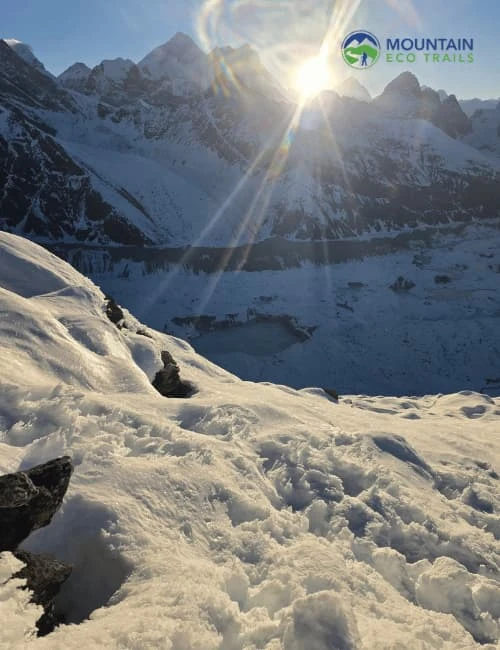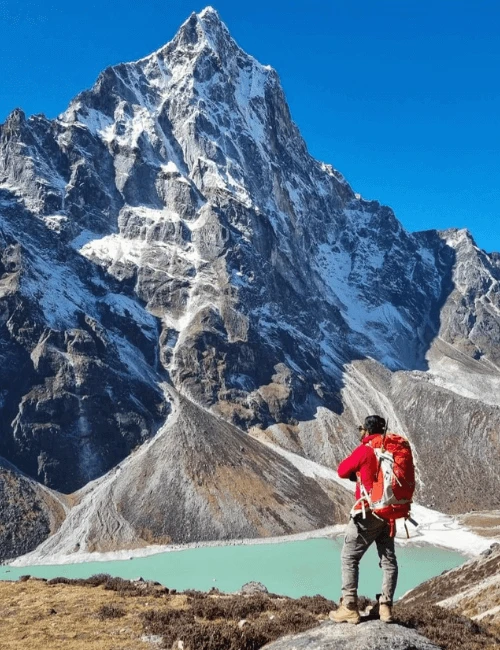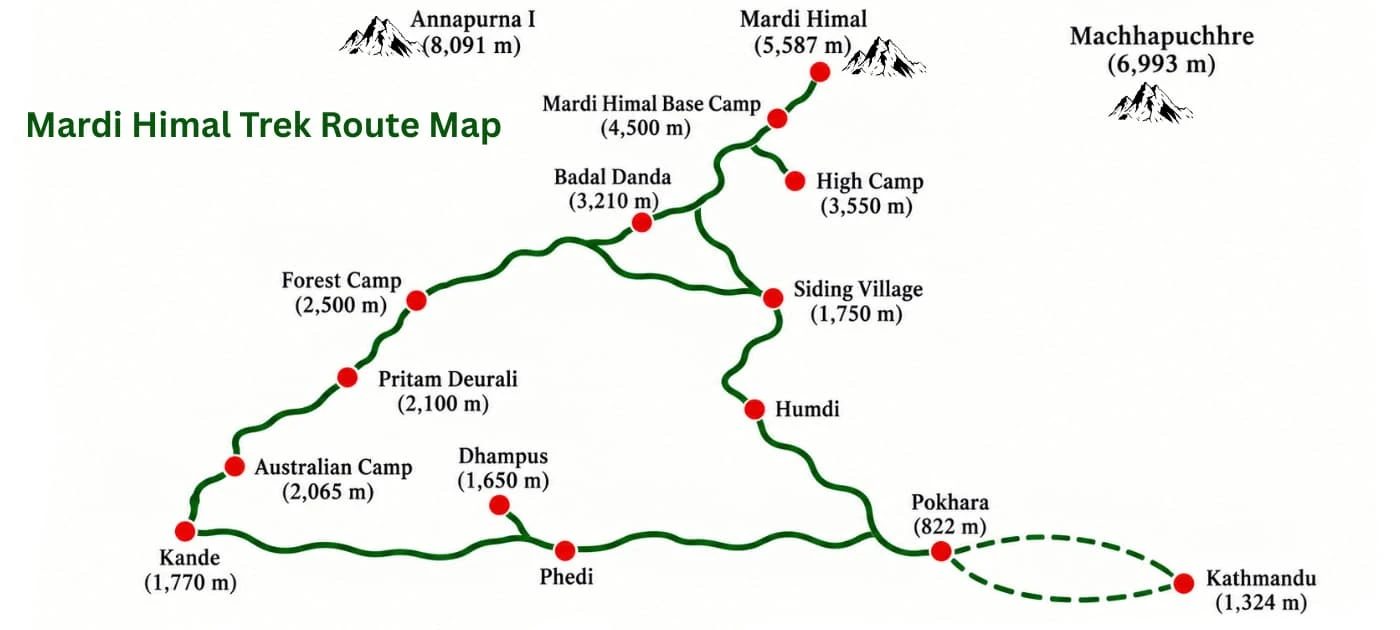
The Mardi Himal Trek route starts near Pokhara and follows Kande, Pitam Deurali, Forest Camp, Low Camp, Badal Danda and High Camp before reaching the Upper Viewpoint or Mardi Himal Base Camp at approximately 4,500 metres. The 40–45 km route usually takes five days and descends through Siding.
The Mardi Himal Trek Route Isn’t One Trail: Here’s How to Plan It
Beyond the Map: Choosing the Right Mardi Himal Trek Route
The standard Mardi Himal Trek route starts near Pokhara and follows a forested trail to Pitam Deurali, Forest Camp, Low Camp, Badal Danda and High Camp. Trekkers then hike towards the Upper Viewpoint or Mardi Himal Base Camp before descending through Siding. Most people complete the route in 5 trekking days.
The Mardi Himal Trek may look short on a map, but the distance makes it a bit challenging. The route takes you to 4500 meters from Pokhara within a few days. So, a sensible trekking pace matters because of the rapid altitude gain and uneven forest trails.
This guide explains the main trailheads, daily stages, alternative routes, approximate distances and the itinerary most suitable for a beginner.
Mardi Himal Trek Route at a Glance
Trek fact | Route information |
Trekking region | Annapurna Conservation Area, Nepal |
Nearest city | Pokhara |
Standard starting point | Kande |
Alternative starting points | Phedi, Dhampus or Siding |
Standard finishing point | Siding |
Highest overnight stop | High Camp, approximately 3,580 metres |
Upper Viewpoint | Approximately 4,200 metres |
Mardi Himal Base Camp | Commonly stated as approximately 4,500 metres |
Estimated trekking distance | Approximately 40–45 kilometres |
Recommended duration | Five to six trekking days |
Daily walking time | Approximately 4–7 hours |
Difficulty | Moderate, with some challenging upper sections |
Accommodation | Teahouses |
Technical climbing | Not required under normal conditions |
Best suited to | Fit beginners and regular hikers |
Main challenges | Rapid altitude gain, steep climbs, exposed ridge and long descent |
Distances vary according to the chosen trailhead, lodge location, turnaround point, small trail diversions and the road pickup point near Siding. Figures in this guide should therefore be treated as planning estimates rather than fixed GPS measurements.
What Is the Complete Mardi Himal Trek Route?
The most practical point-to-point route is:
Pokhara → Kande → Australian Camp → Pitam Deurali → Forest Camp → Low Camp → Badal Danda → High Camp → Upper Viewpoint or Mardi Himal Base Camp → Badal Danda → Siding → Pokhara
The Mardi Trek route begins with a drive from Pokhara to Kande. From Kande, the trail climbs through the lower foothills before joining the forest route at Pitam Deurali. It then rises northwards through Forest Camp, Low Camp and Badal Danda to High Camp.
The final morning follows the upper ridge towards the Upper Viewpoint. Then, next is Mardi Himal Base Camp, depending on the weather and physical condition of the trekkers. Lastly, descend to Low Camp and split the route towards Siding, which is the ending point of the Mardi Himal Trek Route.
Mardi Himal Trek Route Map Explained
A useful Mardi Himal Trek map should show more than a single line between Pokhara and Base Camp. It should distinguish between:
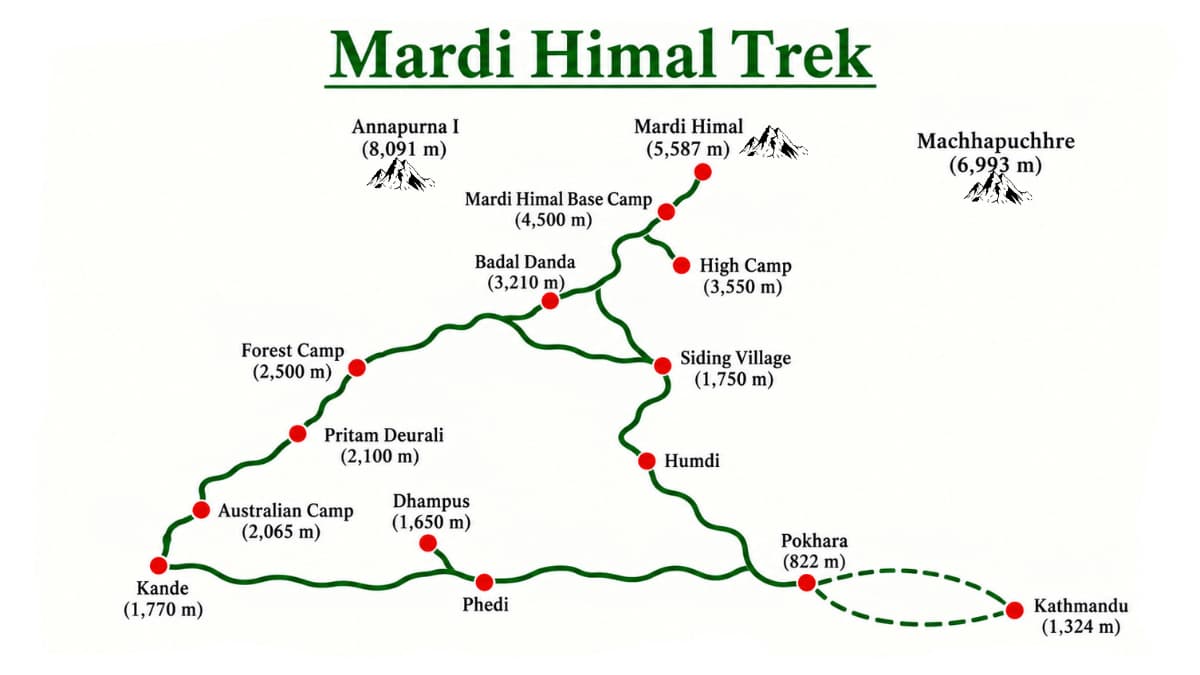
- Vehicle transfers and walking sections
- The Kande and Phedi approaches
- The main overnight stops
- The Upper Viewpoint and Mardi Himal Base Camp
- The Siding and Lumre exits
- Alternative turnaround points
- The main altitude changes
The lower part of the route includes several connected trails used by local communities and trekkers. The itinerary becomes more straightforward after Pitam Deurali, where the trail turns towards Forest Camp and the Mardi ridge.
After Bandal Danda, the ridgeline opens up, and the views start to appear in the distance. This upper section—not the total distance—is what often determines how difficult the trek feels.
Where Does the Mardi Himal Trek Start?
The Mardi Himal Trek starts from several starting point like Kande, Phedi, Dhampus, & even Siding. The Mardi Himal Trek does not have only one compulsory starting point. However, each starting point can create a different itinerary.
Starting from Kande
Kande, at approximately 1,770 metres, is the most common starting point for a 5-Day Mardi Route. After driving from Pokhara, trekkers normally walk through Australian Camp and continue towards Pitam Deurali. This route allows trekkers to gradually adapt to the trail from the lower section before reaching to the high altitude.
Kande is generally the best choice for:
- First-time visitors
- Five- or six-day itineraries
- Trekkers who want a gradual introduction
- Travellers beginning directly from Pokhara
- Point-to-point routes finishing in Siding
Starting from Phedi or Dhampus
Phedi is another starting point reached by driving from Pokhara. The route ascends towards Dhampus and Pothana before joining the trail near Pitam Deurali.
Starting from Phedi adds more climbing through villages and terraced hills. It can be attractive for travellers who want a stronger cultural beginning, but it may make the opening day longer.
Dhampus can also be reached by vehicle, allowing trekkers to avoid part of the climb from Phedi.
This approach is better for:
- Trekkers interested in village scenery
- Longer itineraries
- Travellers staying overnight in Dhampus
- Groups wanting to avoid starting with the busier Kande section
Starting from Siding
Siding is normally the ending point of the Mardi Trek route. However, some trekkers choose this route to shorten the itinerary.
The trail from Siding climbs steeply towards Low Camp or Badal Danda. Although the itinerary can be short, the ascent is hard right from the beginning.
A shorter itinerary is not necessarily an easier itinerary.
Where Does the Mardi Himal Trek Finish?
Most point-to-point itineraries finish at Siding, followed by a jeep transfer to Pokhara.
The walking distance and pickup location may change according to:
- Current road conditions
- Monsoon damage
- Landslides
- Vehicle availability
- How far the jeep can reach
- The particular lodge used the previous night
Lumre is another possible ending point of the Mardi Trek Route.
Standard Five-Day Mardi Himal Trek Route
The 5-day Mardi Trek itinerary offers a reasonable balance between time and effort. Fit beginners can complete it with proper preparation for the consecutive walking days.
Day 1: Pokhara to Kande and Trek to Pitam Deurali
- Route: Pokhara → Kande → Australian Camp → Pitam Deurali
- Starting altitude: Kande, approximately 1,770m
- Sleeping altitude: Pitam Deurali, approximately 2,100m
- Walking time: 3–4 hours
- Estimated distance: 6–8km
After driving from Pokhara to Kande, the trail climbs towards Australian Camp. This opening section combines stone steps, village paths and forest.
Australian Camp offers broad views in clear weather, while Pitam Deurali sits at a junction connecting the Mardi Himal and Annapurna foothill trails.
Sleeping at Pitam Deurali makes the first day relatively gentle. Stronger groups sometimes continue to Forest Camp, but doing so creates a much longer opening stage.
Day 2: Pitam Deurali to Forest Camp
- Route: Pitam Deurali → Forest trail → Forest Camp
- Starting altitude: Approximately 2,100m
- Sleeping altitude: Approximately 2,500–2,550m
- Walking time: 4–5 hours
- Estimated distance: 7–9km
The path leaves the villages slowly and enters dense rhododendron and oak forest. Most of the day, you won't be able to see the views today.
The trail is uneven, with ups and downs. Damp roots, mud and fallen leaves can make this section slippery during or immediately after rain.
Forest Camp contains several teahouses and is a logical overnight stop before entering higher terrain.
Day 3: Forest Camp to High Camp via Low Camp and Badal Danda
- Route: Forest Camp → Low Camp → Badal Danda → High Camp
- Starting altitude: Approximately 2,500m
- Sleeping altitude: Approximately 3,580m
- Walking time: 5–7 hours
- Estimated distance: 8–10km
This is the most important acclimatisation stage of the trek.
The route first climbs through forest to Low Camp. Above Low Camp, the trees begin to thin, and the trail approaches Badal Danda, where the landscape opens dramatically.
On a clear day, Machhapuchhre appears almost directly ahead, with Annapurna South and Hiunchuli visible across the surrounding valleys.
The day involves a sleeping-altitude gain of roughly 1,000 metres if travelling directly from Forest Camp to High Camp. That is a substantial increase. Beginners, slow walkers or anyone reacting poorly to altitude should consider sleeping at Low Camp or Badal Danda instead.
Reaching High Camp quickly should never take priority over headaches, unusual fatigue, dizziness, nausea or loss of coordination.
Day 4: High Camp to Upper Viewpoint or Base Camp and Descend to Badal Danda
- Route: High Camp → Upper Viewpoint → Mardi Himal Base Camp, conditions permitting → High Camp → Badal Danda
- Starting altitude: Approximately 3,580m
- Maximum altitude: Approximately 4,200–4,500m
- Sleeping altitude: Badal Danda, approximately 3,210m
- Walking time: 7–8 hours
- Estimated distance: 12–14km
This part of the route is usually the hardest and most memorable part of the trek.
Trekkers leave early and follow the ridge above High Camp. The path becomes narrower, more exposed and increasingly affected by wind, snow or ice. Although there is no technical climbing in normal conditions, secure footing and comfort on steep mountain paths are necessary.
Most of the trekkers end their trek at Upper Viewpoint. Whereas trekkers in good physical condition can push to Mardi Himal Base Camp if the weather is fine to continue.
After returning to High Camp, many itineraries continue downhill to Badal Danda. This reduces the sleeping altitude and makes the final descent more manageable.
Day 5: Badal Danda to Siding and Drive to Pokhara
- Route: Badal Danda → forest descent → Siding → Pokhara
- Starting altitude: Approximately 3,210m
- Finishing walking altitude: Approximately 1,700m
- Walking time: 4–6 hours
- Driving time: Approximately 2–3 hours
The Siding trail loses considerable elevation over a relatively short period. Long downhill sections can be tiring on the knees, particularly after the previous day’s Base Camp hike.
Trekking poles are valuable here even for travellers who did not need them during the ascent.
The jeep pickup location can change with road conditions. The day may therefore include additional walking below the expected endpoint.
Mardi Himal Trek Distance and Elevation Table
Trekking stage | Approx. distance | Altitude change | Walking time | Main character |
Kande–Pitam Deurali | 6–8km | 1,770m–2,100m | 3–4 hours | Stone steps, villages and forest |
Pitam Deurali–Forest Camp | 7–9km | 2,100m–2,500m | 4–5 hours | Undulating forest trail |
Forest Camp–High Camp | 8–10km | 2,500m–3,580m | 5–7 hours | Steep forest climb and open ridge |
High Camp–Base Camp–Badal Danda | 12–14km | 3,580m–4,500m–3,210m | 7–8 hours | High ridge, exposure and long descent |
Badal Danda–Siding | 7–9km | 3,210m–1,700m | 4–6 hours | Sustained steep descent |
Estimated total | 40–45km | — | Five trekking days | Point-to-point route |
The distances are approximate
Upper Viewpoint vs Mardi Himal Base Camp
The Upper Viewpoint and Mardi Himal Base Camp should not be treated as the same place.
Feature | Upper Viewpoint | Mardi Himal Base Camp |
Approximate altitude | Around 4,200m | Commonly stated around 4,500m |
Position | Above High Camp on the upper ridge | Farther along the high route |
Walking commitment | Shorter turnaround | Longer and more demanding |
Exposure | Significant | Potentially greater |
Suitable in poor conditions | Often used as the safer turnaround | Not always advisable |
Mountain views | Excellent | Closer perspective when clear |
We, Mountain Eco Trails, treat reaching the higher point as conditional. Snow, wind, poor visibility, trail damage, altitude symptoms or slow progress can make the Upper Viewpoint the responsible destination.
Turning around is not a failed trek. On this route, the best decision is the one that gets everyone safely back below High Camp.
Four-Day, Five-Day or Six-Day Mardi Himal Route?
Duration | Best for | Main concern |
Four trekking days | Strong hikers with previous altitude experience | Rapid ascent and long walking days |
Five trekking days | Fit beginners and regular hikers | Still requires a significant ascent to High Camp |
Six trekking days | First-time trekkers who prefer a steadier pace | Requires an additional travel day |
Seven or more days | Families, photographers or slower walkers | Higher overall trip cost |
Four-day route
A 4-day Mardi Himal Trek route may combine Kande to Forest Camp on the first day and Forest Camp to High Camp on the second. It saves time but creates two demanding climbing days followed by the high-point excursion.
This route or itinerary is not for absolute beginners.
Five-day route
Mardi Himal Trek 5-day route is perfect for fit travellers who regularly walk or hike. It creates more time on the lower trail but can still involve a large altitude increase between Forest Camp and High Camp.
Six-day route
Likewise, a six-day itinerary can divide the trek with an overnight at Low Camp or Badal Danda. For beginners, this is often a better use of one extra day than adding general sightseeing elsewhere in the itinerary.
Is the Mardi Himal Trek Route Suitable for Beginners?
Yes, a fit beginner can complete the Mardi Himal Trek on a sensible 5- or 6 Day itinerary. However, it is not an easy walk. The route reaches approximately 4,500 metres and includes steep forest climbs, rapid altitude gain, an exposed upper ridge and a long descent towards Siding.
Previous mountaineering experience is not necessary, but beginners should ideally be able to:
- Walk uphill and downhill for five to seven hours
- Complete consecutive hiking days
- Carry a small daypack
- Remain comfortable on narrow mountain paths
- Follow a conservative pace
- Change plans if weather or health requires it
Four to six weeks of preparation can make the trek more enjoyable. Hill walking, stair climbing, cycling and longer weekend hikes are more useful than focusing only on speed.
Click here to know more about Mardi Himal Trek difficulty for beginners and decide which itinerary & route is best for you.
What Is the Hardest Part of the Mardi Himal Route?
The hardest part of the Mardi Himal Route is the early morning hike to the Mardi Himal Base Camp. Climbing from the High Camp early in the cold morning above 4000 meters can be challenging. Moreover, the trail section is narrow until the Base Camp.
Some trekkers find the descent to Siding harder on their legs than the ascent. Travellers with knee problems should use trekking poles, keep their pack light and consider dividing the descent.
Mardi Himal Route Conditions by Season
Season | Typical conditions | Route consideration |
March–May | Mild lower trails, flowering rhododendrons and possible afternoon cloud | Popular period; book limited High Camp rooms early |
June–August | Rain, mud, leeches, cloud and possible road disruption | Slippery forest sections and limited mountain visibility |
September–November | Generally clearer views and busy teahouses | Strong season, but crowding can affect rooms |
December–February | Cold nights, possible snow and ice above Badal Danda | Upper-ridge access may be restricted by conditions |
Mountain weather does not follow a fixed calendar. Rain, snow, wind and cloud can occur outside their usual seasons, so current local conditions matter more than a general monthly description.
Check our Mardi Himal Trek Best Time seasonal guide.
Common Mardi Himal Route Mistakes
Rushing directly to High Camp
The trail may be short in kilometres, but the sleeping-altitude gain can be aggressive. Adding a night at Low Camp or Badal Danda is often wiser than rushing to High Camp.
Confusing the Upper Viewpoint with Base Camp
Confirm your ideal destination before departing for the trek.
Underestimating the Siding descent
The final descent can be steep, slippery and demanding on tired knees.
Depending entirely on an online GPS track
Trails and road access can change. Offline mapping is useful, but it should not replace current local information.
Packing for Pokhara instead of High Camp
Warm conditions in Pokhara do not reflect the cold, wind and possible snow above High Camp.
Treating the trek as easy because it is non-technical
No ropes or climbing skills are normally needed, but altitude and exposure remain real challenges.
Which Mardi Himal Route Should You Choose?
Choose the Kande to Siding five-day route if you are fit, have limited time and want a complete point-to-point journey.
Choose a six-day route with Low Camp or Badal Danda as an extra overnight stop if this is your first Himalayan trek or you prefer a relaxed itinerary.
Choose the Phedi or Dhampus approach if village landscapes and a longer lower route are important to you.
Avoid the shortest Siding ascent unless you are comfortable with steep climbing and understand that saving a day usually increases the physical and altitude demands.
Frequently Asked Questions
How long is the Mardi Himal Trek route?
The standard Kande-to-Siding route covers approximately 40–45 kilometres. The exact distance depends on the trailhead, lodge stops, whether the trek ends at the Upper Viewpoint or Base Camp, and the current road pickup point.
How many days are needed for the Mardi Himal Trek?
You will need at least 4-5 days for the Mardi Himal Trek. Fit and experienced hikers sometimes complete it in four, while a six-day itinerary is better for beginners, photographers and trekkers wanting a more gradual ascent.
Where does the Mardi Himal Trek start?
Often the Mardi Himal Trek starts from Kande. Alternative routes begin from Phedi, Dhampus or Siding. Kande works particularly well for a standard point-to-point itinerary finishing at Siding.
What is the highest point of the Mardi Route?
Mardi Himal Base Camp at 4500 meters is the highest point of the Mardi Route. The Upper Viewpoint, at around 4,200 metres, is a separate and frequently used turnaround point.
Is the Mardi Himal route well marked?
Yes, the Mardi Himal Route is well marked. However, weather, snow, darkness and intersecting lower trails can complicate navigation. Trekkers should not rely solely on painted markers.
Is Mardi Himal Trek technically difficult?
No technical climbing is normally required. Nevertheless, the upper trail can become difficult or unsafe during snow, ice, strong wind or poor visibility.
Can the Mardi Himal route be shortened?
Yes, but shortening the trek usually means longer days or faster altitude gain. A rushed itinerary and route is best suited to strong hikers rather than travellers looking for the easiest experience.
Plan the Right Mardi Himal Route for Your Experience
The best Mardi Himal route is not always the shortest one. Your ideal plan depends on your fitness, hiking background, travel month, available days and comfort at altitude.
Mountain Eco Trails organises private Mardi Himal treks from Pokhara with licensed guides, permits, teahouse accommodation, meals and required transfers. The itinerary can be adjusted for fit beginners, couples, families and experienced hikers.
Share your travel date, group size and preferred number of trekking days, and we will recommend an appropriate trailhead, overnight plan and descent route. Contact us via email or WhatsApp us at +9779849790153.
- Written by: Anil Lamsal
- Technical review: [Samrat Shrestha], licensed Annapurna-region trekking guide
- Route last inspected: [08/2026]
- Last fact-checked: [11/09/2026]
- Sources checked: Nepal Tourism Board, NTNC/Annapurna Conservation Area and Mountain Eco Trails guide records

Anil Lamsal
Call us on WhatsApp+977 9849790153OrChat with us