
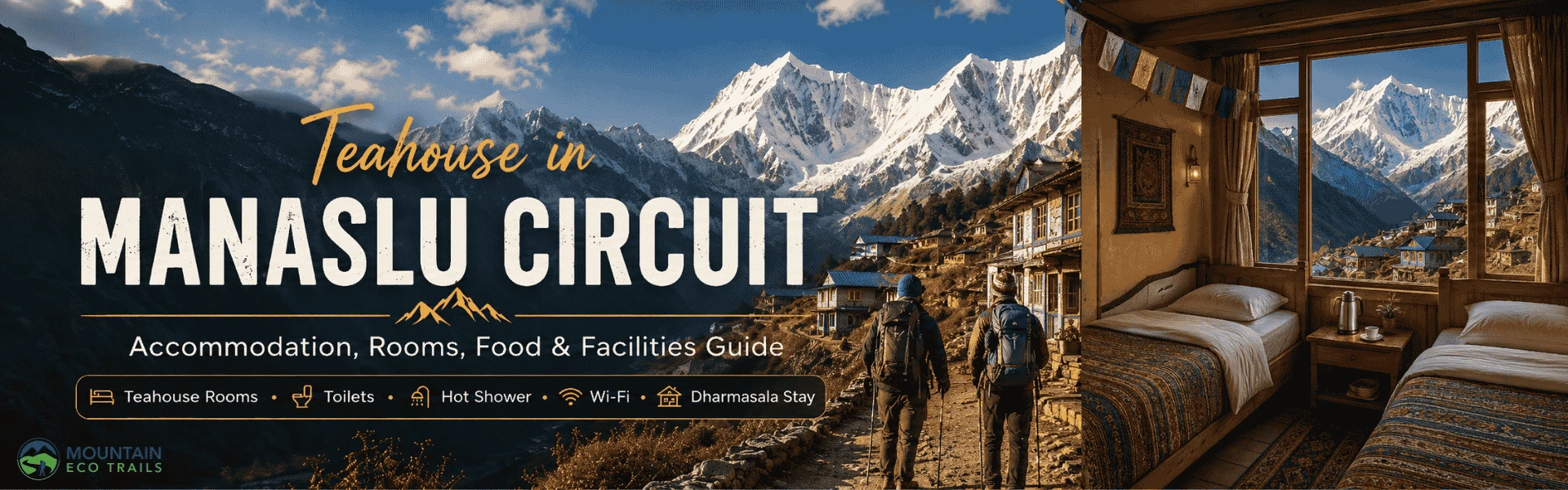
A teahouse in Manaslu Circuit is a simple mountain lodge where trekkers sleep, eat, and rest during the trek. Most Manaslu Circuit teahouses offer twin-sharing rooms, basic beds, shared toilets, warm dining areas, and freshly cooked meals like dal bhat, noodles, soup, rice, potatoes, eggs, and tea. Facilities become more basic as you climb higher, especially around Samdo and Dharamsala before Larkya La Pass. Seasoned trekkers should expect remote comfort, not luxury, and should carry a warm sleeping bag, cash, a power bank, and essential toiletries.
Introduction: What Trekkers Should Know First
The Manaslu Circuit Teahouse experience is one of the biggest reasons this trek feels raw, local, and deeply Himalayan. Unlike Everest or Annapurna, Manaslu still has a quieter trail culture. The lodges are smaller, the villages feel more traditional, and the comfort level changes quickly with altitude.
For seasoned trekkers, this guide answers the real questions: Are the rooms warm in Manaslu? Are toilets clean? Is Wi-Fi available in the Manaslu Trek? Can you get a hot shower in Manaslu Teahouse? What is Dharmasala accommodation Manaslu really like before crossing Larkya La?
The honest answer is simple: Manaslu is comfortable enough for prepared trekkers but basic enough to feel remote. The Manaslu Circuit Trek accommodation style rewards those who value authenticity over luxury.
What Are Teahouses Like on the Manaslu Circuit?
Teahouses on the Manaslu Circuit are locally run mountain lodges with basic twin rooms, simple beds, shared toilets, and a communal dining room. Meals are cooked fresh, and facilities are more reliable in lower villages. Higher sections, especially Dharmasala, have limited rooms, colder nights, and fewer comforts.
In short:
- Rooms are basic but usable.
- Toilets are usually shared.
- Dining rooms are warmer than bedrooms.
- Hot showers and Wi-Fi cost extra where available.
- Dharmasala is the most limited overnight stop.
- A sleeping bag is strongly recommended.
What Is a Teahouse in Manaslu Circuit?
A teahouse in Manaslu Circuit is a family-run mountain guesthouse along the trekking trail. It works as a place to sleep, eat, warm up, refill water, meet other trekkers, and experience local hospitality.
In lower villages such as Machha Khola, Jagat, Deng, Namrung, and Lho, teahouses are usually more comfortable. In higher villages such as Samagaun, Samdo, and Dharmasala, the facilities become simpler because supplies must be carried higher into remote terrain.
The Manaslu Circuit is no longer a full camping-only route for most trekkers. Today, it is commonly done as a teahouse trek, meaning trekkers stay in local lodges each night. The experience is basic, warm, social, and practical, but it is not luxury trekking.
Is Manaslu Circuit a Teahouse Trek or a Camping Trek?
The Manaslu Circuit is now mainly a Manaslu Teahouse Trek. Most guided itineraries use teahouses or mountain lodges from the starting villages through Bimthang and Dharapani.
Camping is still possible for special groups, photography expeditions, remote side trips, or customised routes. However, most trekkers do not need tents for the standard Manaslu Circuit route.
| Trek Style | Best For | Comfort Level | Cost | Practicality |
|---|---|---|---|---|
| Teahouse Trek | Most trekkers | Basic to moderate | Lower | Most practical |
| Camping Trek | Remote expedition-style groups | More controlled but harder to organize | Higher | Requires full crew |
| Luxury Trek | Not realistic on full Manaslu route | Limited | Higher | Not widely available |
| Hybrid Trek | Custom groups | Flexible | Medium to high | Good for special routes |
For seasoned trekkers, the teahouse style is usually the best choice. It keeps the trek light, supports local families, and allows you to move efficiently through remote villages.
Manaslu Circuit Trek Teahouse Rooms: What to Expect
Manaslu Circuit Trek Teahouse Rooms are simple. Most rooms have two single beds, thin mattresses, pillows, and sometimes blankets. Walls may be made of wood, plywood, or stone, and insulation is limited.
Bedrooms are usually not heated. The warmest place is the dining room, where trekkers gather around the stove in the evening.
Typical Room Features
| Feature | What to Expect |
|---|---|
| Bed type | Twin-sharing single beds |
| Mattress | Thin but usable |
| Blanket | Sometimes available |
| Heating | Usually only in dining room |
| Private room | Possible in lower villages, limited higher up |
| Electricity | Available in some lodges, often paid |
| Noise level | Thin walls, bring earplugs |
| Best gear | Warm sleeping bag and liner |
Some operators mention twin-sharing rooms as the common standard, and private rooms may be possible at extra cost, but cannot always be guaranteed in Dharmasala due to limited space.
Manaslu Circuit Lodge Accommodation by Village
The quality of Manaslu Circuit Lodge Accommodation changes by village. Lower villages have easier supply access, while higher villages face altitude, weather, and transport limitations.
| Trek Section | Common Villages | Accommodation Level |
|---|---|---|
| Lower Manaslu | Machha Khola, Jagat | Basic to moderate |
| Middle Manaslu | Deng, Namrung, Lho | Moderate by Manaslu standards |
| High Manaslu | Samagaun, Samdo | Basic to moderate |
| Pre-pass Zone | Dharmasala | Very basic |
| Post-pass Zone | Bimthang, Tilije | Basic to moderate |
The best teahouse experience on Manaslu is not always about the softest bed. It is about timing, acclimatization, warm food, and a guide who knows which lodge is reliable in each village.
Dharmasala Accommodation Manaslu: The Most Basic Night
Dharmasala Accommodation Manaslu is the most important place to understand before starting the trek. Dharmasala, also known as Larke Phedi, is the final overnight stop before crossing Larkya La Pass.
It sits at high altitude, around 4,460 meters, and has only a few basic lodges or huts. The stop is useful because it places trekkers closer to the pass, but comfort is limited. Weather can be harsh, rooms can fill quickly, and shared sleeping space may happen in busy seasons.
What to Expect in Dharamsala
- Very basic rooms or shared sleeping space
- Cold night temperatures
- Limited toilets
- Limited washing facilities
- Simple meals
- Early sleep before the pass day
- A very early start for Larkya La
This is not the night to expect comfort. It is the night to stay warm, hydrate, eat well, and prepare mentally for the longest day of the trek.
Manaslu Circuit Trek Toilet Facilities
Manaslu Circuit Trek toilet facilities are basic and usually shared. In lower villages, some lodges may have Western-style toilets, but squat toilets are common. At higher elevations, toilets become simpler and colder.
Do not expect attached bathrooms like in city hotels. Even when a lodge looks comfortable, bathrooms are usually outside the room.
Toilet Reality Checklist
| Facility | Lower Villages | Higher Villages |
|---|---|---|
| Shared toilet | Common | Common |
| Western toilet | Sometimes | Rare |
| Squat toilet | Common | Common |
| Attached bathroom | Rare | Very rare |
| Running water | Often | Not always reliable |
| Toilet paper | Usually not provided | Bring your own |
| Night access | Can be cold | Very cold |
Carry toilet paper, wet wipes, hand sanitiser, and a small headlamp. A headlamp is especially useful for night toilet visits in Samdo and Dharmasala.
Hot Shower in Manaslu Circuit
A hot shower in the Manaslu Circuit is available in some teahouses, especially in lower and middle villages. It usually costs extra. In higher villages, hot showers may be limited, expensive, solar-dependent, or unavailable.
A realistic approach is to shower in lower villages and skip showers near the pass. Staying dry and warm is more important than staying perfectly clean at altitude.
Common extra costs listed by trek operators include hot showers, Wi-Fi, and charging, with hot showers often charged separately.
Best Shower Strategy
- Shower in lower villages when available.
- Avoid late evening showers in cold areas.
- Use wet wipes near Samdo and Dharmasala.
- Keep one dry base layer only for sleeping.
- Do not rely on daily showers.
Wi-Fi in Manaslu Circuit Teahouse
Wi-Fi in Manaslu Circuit Teahouse is available in some villages but should not be treated as guaranteed. The connection may be slow, paid, weather-affected, or unavailable during power issues.
Seasoned trekkers should prepare for partial disconnection. This is part of the Manaslu experience.
Connectivity Expectations
| Option | Reliability | Best Use |
|---|---|---|
| Teahouse Wi-Fi | Low to moderate | Simple messages |
| Local SIM | Works in some areas | Backup connection |
| Power bank | Very useful | Charging independence |
| Satellite device | Best for remote safety | Emergency communication |
How Much Extra Cash Do You Need for Manaslu Teahouses?
Even when your package includes meals and accommodation, you still need cash for personal extras. There are no reliable ATMs on the route, and teahouses generally do not accept cards.
| Extra Item | Estimated Cost |
|---|---|
| Hot shower | USD 3–5 |
| Wi-Fi | USD 3–5 |
| Charging device | USD 2–5 |
| Tea or coffee | Varies by altitude |
| Bottled drinks | Higher cost at altitude |
| Snacks | More expensive than Kathmandu |
| Donations/monastery visits | Optional |
For most trekkers, carrying extra Nepali rupees for personal spending is essential. Some trek operators recommend carrying roughly USD 15–20 per trekking day for extras, depending on spending habits.
What to Pack for a Manaslu Teahouse Trek
A smart packing list makes basic teahouse accommodation much more comfortable.
- Essential Teahouse Gear
- Warm sleeping bag
- Sleeping bag liner
- Headlamp
- Power bank
- Quick-dry towel
- Toilet paper
- Wet wipes
- Hand sanitizer
- Earplugs
- Water purification tablets or a filter bottle
- Warm socks for sleeping
- Down jacket
- Dry base layer for night
- Cash in Nepali rupees
Do not pack like you are going to a hotel trek. Pack like you are staying in remote mountain homes with limited heat, basic bathrooms, and unpredictable electricity.
Best Tips for Seasoned Trekkers
Seasoned trekkers usually adapt well to Manaslu because they already understand mountain discomfort. Still, Manaslu has its own rhythm.
Trail-Tested Tips
- Choose dal bhat before hard days.
- Keep a dry sleeping layer separate.
- Charge devices whenever power is available.
- Carry small cash notes.
- Do not wait until Dharamsala to solve gear problems.
- Use Samagaun and Samdo for acclimatisation.
- Keep expectations realistic.
- Respect local lodge owners and village customs.
- Avoid comparing every facility to Everest.
- Book with a local team that knows lodge availability.
The best way to enjoy Manaslu teahouses is to expect simplicity. Lower villages offer better comfort, while higher villages are colder and more limited. A warm sleeping bag, flexible mindset, cash, and a reliable guide make the accommodation experience smoother and safer.
Why Book a Guided Manaslu Teahouse Trek?
A guided Manaslu trek is not only about route navigation. A good local guide helps with lodge selection, room arrangements, meal timing, altitude pacing, permit coordination, and communication with teahouse owners.
For seasoned trekkers, this removes uncertainty before the remote sections. It also supports local communities directly.
Planning the Manaslu Circuit and want a realistic lodge-by-lodge briefing before you go? Mountain Eco Trails can help you organize a guided Manaslu Teahouse Trek with local expertise, proper acclimatisation, and clear expectations for every overnight stop. Contact us via email or WhatsApp us at +9779849790153.
FAQs: Teahouse in Manaslu Circuit
1. Are there teahouses on the Manaslu Circuit?
Yes, there are teahouses along the standard Manaslu Circuit route. Trekkers usually stay in local lodges in villages such as Machha Khola, Jagat, Deng, Namrung, Lho, Samagaun, Samdo, Dharmasala, Bimthang, and Tilije.
2. What are teahouses like on Manaslu Circuit?
Teahouses are simple mountain lodges with basic twin rooms, shared toilets, warm dining areas, and cooked meals. They are comfortable enough for prepared trekkers but not luxurious. Facilities become more basic as the trail climbs higher toward Larkya La.
3. Do Manaslu Circuit teahouses have hot showers?
Some teahouses offer hot showers, mostly in lower and middle villages. Hot showers usually cost extra and may not be available at higher elevations. Near Samdo and Dharmasala, trekkers should expect limited washing facilities and colder conditions.
4. Is Wi-Fi available in Manaslu Circuit teahouses?
Wi-Fi is available in some Manaslu teahouses, but it is usually slow, paid, and unreliable. Weather, power supply, and altitude can affect service. Trekkers should download maps offline and carry a power bank instead of relying on regular internet.
5. Do I need a sleeping bag for Manaslu Circuit teahouses?
Yes, a warm sleeping bag is strongly recommended. Teahouses provide beds and sometimes blankets, but rooms are not heated. At higher villages, especially Samdo and Dharmasala, nights can be very cold, and a good sleeping bag improves comfort.
6. What is the Dharmasala accommodation like in Manaslu?
Dharamsala accommodation is very basic and limited. It is the final stop before Larkya La Pass, so trekkers usually stay only one night. Rooms may be shared in busy seasons, toilets are simple, and comfort is lower than in bigger villages.
7. Are private rooms available on the Manaslu Circuit?
Private rooms may be available in some lower and middle villages, depending on season and availability. However, they are not guaranteed in higher areas. Dharmasala has limited space, so twin-sharing or shared sleeping arrangements may be necessary.
8. What food do teahouses serve on Manaslu Circuit?
Most teahouses serve dal bhat, noodles, soup, fried rice, potatoes, eggs, pancakes, Tibetan bread, pasta, tea, and coffee. Dal bhat is the most reliable meal for energy because it is filling, warm, and commonly available throughout the route.
9. How much cash should I carry for teahouse extras?
Carry Nepali rupees for hot showers, Wi-Fi, charging, snacks, bottled drinks, tips, and donations. Even if your package includes meals and accommodation, personal extras are usually paid separately. There are no reliable ATMs on the trekking route.
10. Is the Manaslu teahouse trek suitable for seasoned trekkers?
Yes, the Manaslu teahouse trek is ideal for seasoned trekkers who want a remote Himalayan route with basic accommodation. It is less polished than Everest or Annapurna but offers stronger wilderness, cultural depth, and a more authentic mountain lodge experience.
Conclusion
A teahouse in Manaslu Circuit gives you a simple but meaningful mountain experience. You sleep in local lodges, eat warm meals, share dining rooms with other trekkers, and move through villages that still feel deeply connected to the landscape.
The comfort is basic, especially near Dharamsala, but that is part of the route’s character. For seasoned trekkers, Manaslu offers the right balance: remote enough to feel adventurous, supported enough to avoid camping, and authentic enough to stay memorable long after the trek ends.
With the right guide, realistic expectations, and smart packing, the Manaslu Circuit Trek accommodation experience becomes one of the most rewarding parts of the journey.