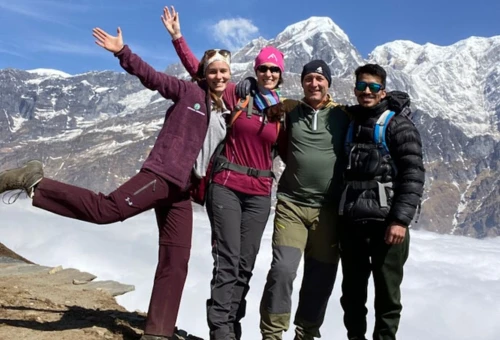
Khopra Danda Trek

tripadvisor rating1 Reviews
google rating20 Reviews

The Khopra Danda Trek is one of the best quiet treks in Nepal for beginners who want big mountain views without the crowds of busier Annapurna routes. This 10-day guided trek offers Khopra Ridge, optional Khayer Lake, village culture, community lodges, and a moderate challenge that feels adventurous but achievable. Explore the itinerary, cost, best time, difficulty, and practical planning tips before you book.

  • DestinationNepal
  • Duration10 Days
  • Difficulty Level Moderate
  • Max. Altitude4600 meters
  • Starts/EndsBirethanti/Ghandruk
  • Trip Distance75 KM
  • Trip StyleTrekking
  • Group SizeMin. 1 pax.
  • Best SeasonSpring, Autumn and Winter

The Khopra Danda Trek is a 10-day guided journey in Nepal's Annapurna region, known for quieter trails, community lodges, and panoramic views of Dhaulagiri, Annapurna South, Nilgiri, and nearby Himalayan peaks.

Located away from the busiest Annapurna trails, Khopra Danda offers a different experience from the popular Poon Hill and Annapurna Base Camp routes. You still walk through mountain villages, rhododendron forests, and terraced hillsides, but the journey gradually becomes quieter as you approach Khopra Ridge.

The trek reaches Khopra Ridge at approximately 3,660 meters (12,008 feet), with an optional, more challenging hike to Khayer Lake at around 4,660 meters (15,289 feet).

Starting and ending in Kathmandu, the Mountain Eco Trails itinerary combines Poon Hill, traditional villages, forests, and a scenic ridge walk. Rated moderate, it suits fit beginners and intermediate hikers who prefer a less-travelled Annapurna route.

The Khopra Danda Trek is less crowded than the busy Annapurna Trails. It is best for travellers who seek mountain views, local culture, community lodges, and a moderate trekking challenge.

Mountain Eco Trails operates this 10-day Khopra Danda Trek in the Annapurna region, with Khopra Ridge at 3,660 m as the highest Point. It also offers an optional Khayer Lake side hike to around 4,660 m. It suits beginners who want a scenic, less-crowded Nepal trek with guide support and a clear itinerary.

You will get dramatic sunrise views, forest trails, Gurung and Magar villages, and the chance to add Poon Hill, but the overall feel is calmer and more personal. For many first-time visitors to Nepal, that balance is exactly what makes this trek so appealing.

Is Khopra Danda Trek Worth Doing?

Yes. Khopra Danda is worth doing and an excellent choice for those who want wide Himalayan views, quieter trails, and an experience beyond the standard Annapurna viewpoints. It is a good choice for fit first-time Himalayan trekkers. There is a Khayer Lake Hike extension to make the trek more challenging. 

Planning a Khopra Danda Trek?

Send Mountain Eco Trails your travel month, number of trekkers, and whether you want a porter or the Khayer Lake excursion. We can help you compare the standard package with a private or customised itinerary.

Email: [email protected]
WhatsApp: +977 9849790153
Khopra Danda Trek Highlights

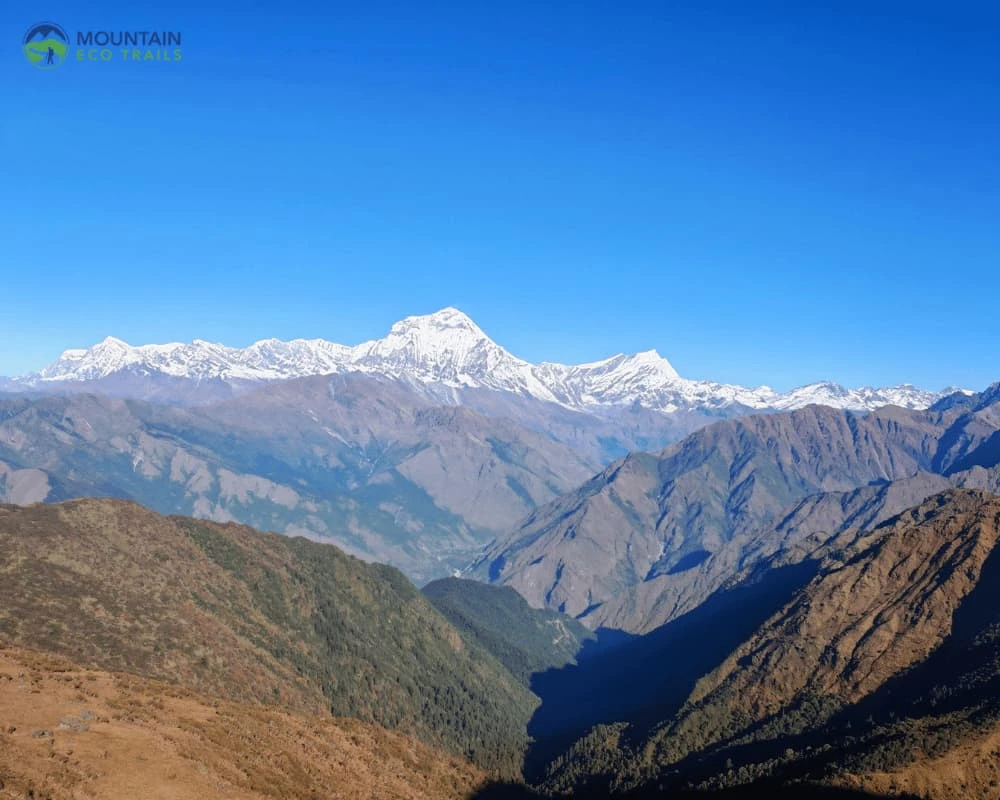
  • Stay on Khopra Ridge at approximately 3,660 meters with wide views of the Annapurna and Dhaulagiri ranges.
  • Visit Poon Hill at 3,210 meters for a possible Himalayan sunrise.
  • Walk through rhododendron and oak forests above Ulleri, Ghorepani, and Tadapani.
  • Experience traditional settlements such as Swanta and Ghandruk.
  • Stay in simple teahouses and community-based mountain lodges.
  • Enjoy a less-busy trekking atmosphere after leaving the main Ghorepani trail.
  • Take an optional full-day hike to sacred Khayer Lake at approximately 4,660 meters.
  • Explore varied terrain, from cultivated hillsides to exposed alpine ridges.
  • Finish the journey in Ghandruk, a traditional Gurung village with views of Annapurna South and Machhapuchhre.
  • Travel with a licensed local guide and a prearranged trekking itinerary.

Why Choose Khopra Danda Instead of a Busier Annapurna Trek?

Most of the travellers only heard about popular Annapurna Base Camp Trek or Annapurna Circuit Trek. Only a few know about the Khopra Danda Trek, and it's a quieter trail. Recently, Khopra Danda has been getting popular due to its access, rewarding mountain scenery, and remote-feeling accommodation. 

1. A Mountain Ridge Rather Than a Crowded Viewpoint

At Poon Hill, trekkers generally arrive early for sunrise and return to Ghorepani afterwards. Khopra Ridge offers a different experience.

You stay overnight close to the viewpoint, so the surrounding mountains become part of your entire evening and morning rather than a single sunrise stop.

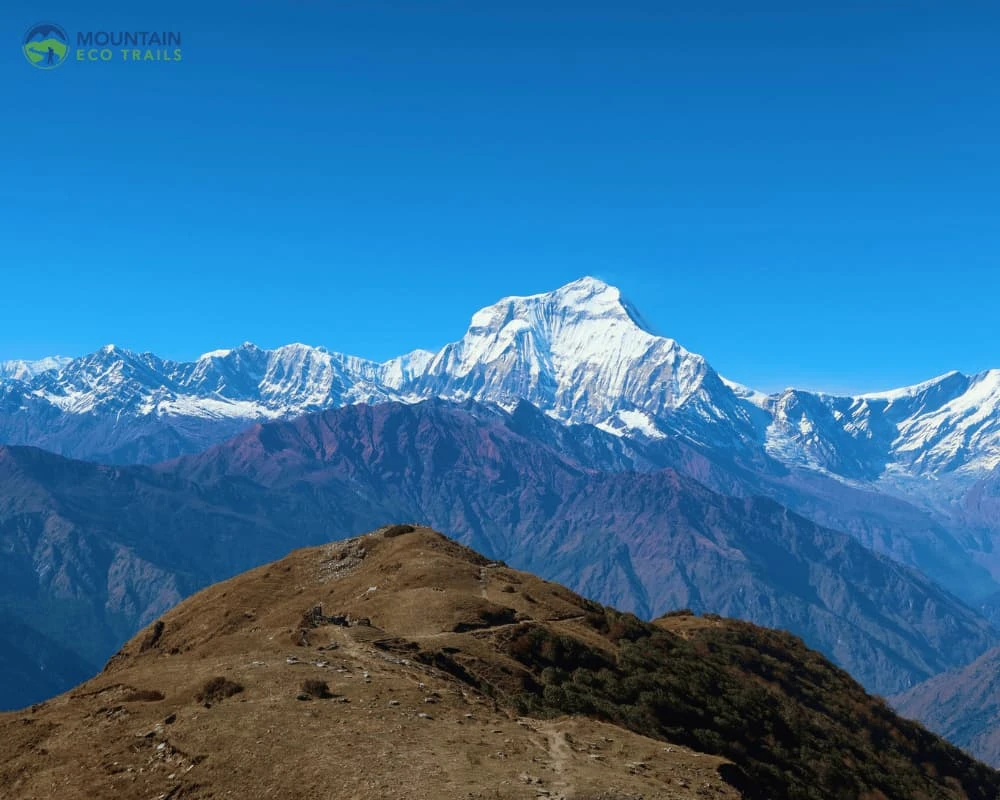
On a clear day, Dhaulagiri dominates the western skyline, while Annapurna South and the Nilgiri mountains add depth to the panorama.

You can sit outside the lodge, enjoy a hot drink, and watch the changing light without rushing back down immediately.

2. A More Interesting Route Than Simply Walking Up and Back

Our Khopra Danda Trek route begins on the familiar Ghorepani trail but later moves toward Swanta and Khopra. The return journey follows Bayeli, Dobato, Tadapani, and Ghandruk instead of retracing the entire ascent.

This matters because the landscapes change.

One day, you are walking beneath thick forest cover. Another day, you are following an exposed ridge with distant mountain views. Later, you descend toward traditional villages and warmer valleys.

The route feels like a journey through several different environments rather than a single viewpoint hike.

3. Community Lodges With a Different Purpose

One of the distinctive features of the Khopra Danda Community Trek is its connection with community-based accommodation. Along parts of the route, small community lodges provide simple rooms and meals for trekkers.

These establishments are not luxury mountain hotels. Facilities can be limited, especially during colder weather. However, they help make trekking possible on routes that have fewer commercial lodges than the main Annapurna corridor.

4. An Optional Adventure to Khayer Lake

Khopra Ridge itself is a worthwhile destination. For stronger hikers, Khayer Lake adds another challenge.

The lake lies significantly higher than the ridge, making it a long and demanding day hike. Travellers who prefer a relaxed schedule can stay around Khopra instead.

That flexibility makes this route attractive to groups with different levels of hiking experience, although any group separation or alternative activity must be coordinated safely with the guide.

5. A Route That Still Includes Poon Hill

Choosing Khopra does not mean you have to skip Poon Hill. Our standard itinerary includes a sunrise excursion to Poon Hill before continuing toward Swanta.

You experience one of Nepal's well-known Himalayan viewpoints, then spend the following days exploring a quieter part of the Annapurna region.

For first-time visitors who want both a recognisable destination and a less-common trekking experience, this combination works particularly well.

Who is the Khopra Danda Trek best for?

Best for

  • First-time trekkers in Nepal with decent fitness
  • Travellers wanting a quiet trek in Nepal
  • Couples and friends who want a private guided trip
  • Hikers who like ridge views more than busy trails
  • Travellers who want a moderate adventure in about 10 days
  • Trekkers who prefer authentic village stays over heavy route traffic

Not ideal for

  • Travellers looking for the shortest possible Pokhara loop
  • People who want luxury lodges throughout
  • Trekkers who dislike steep stone steps
  • Travellers who want a combined multi-viewpoint trek with Mohare Danda included

Khopra Danda Trek Itinerary at a Glance

DayRouteOvernight altitudeDuration
1Kathmandu to Pokhara827 m7–9 hours by road
2Pokhara to Birethanti; trek to Ulleri1,960 m6–7 hours trekking
3Ulleri to Ghorepani2,874 m5–6 hours
4Poon Hill sunrise; trek to Swanta2,270 m5–6 hours
5Swanta to Khopra Danda via Chistibang3,660 m6–7 hours
6Optional Khayer Lake hike; return to Khopra3,660 m9–10 hours
7Khopra Danda to Bayeli3,450 m4–5 hours
8Bayeli to Tadapani via Dobato2,620 m5–6 hours
9Tadapani to Ghandruk; drive to Pokhara827 m5–6 hours
10Pokhara to Kathmandu—7-8 hours

Khopra Danda Trek Cost for 2027,2028

Mountain Eco Trails offers this 10-day guided package with transparent inclusions starting from USD 849 per person for a single trekker. It includes required logistics, a guide, permits, transportation, & other components. You can check the cost details below or feel free to contact us via email or WhatsApp at +9779849790153.

Cost Component

Estimated Range (USD)

Trekking Guide for Khopra Danda

30–40 per day

Porter (optional)

25–30 per day

Required Permit Card for Khopra Danda

USD 30-40

Transport during the Trek

USD 80-100

Teahouse/lodge stay in Khopra Danda

USD 8-10 per night

Meals during the trek (Breakfast, Lunch, Dinner)

USD 30-40 per day

Khopra Danda Trek Package cost starts

USD 849

Planning a Khopra Danda Trek?

Send Mountain Eco Trails your travel month, number of trekkers, and whether you want a porter or the Khayer Lake excursion. We can help you compare the standard package with a private or customised itinerary.

Email: [email protected]
WhatsApp: +977 9849790153
Itinerary

Your adventure begins with a scenic drive from Kathmandu to Pokhara, a beautiful lake city. By tourist bus, it’s about 6–7 hours along the Prithvi Highway. You’ll travel alongside rushing rivers and terraced fields, with occasional glimpses of Ganesh and Manaslu Himal on clear days. Upon reaching Pokhara, you can enjoy the evening strolling by Phewa Lake, preparing for the trek ahead. 

  • Max Altitude:827 meters
  • Accommodation:3-Star hotel
  • Time:7-9 hours
  • Meals:Breakfast

After breakfast, travel from Pokhara toward Birethanti, one of the traditional entry points for Annapurna foothill treks.

The walking route initially follows settlements, small bridges, and cultivated valleys. As you approach Tikhedhunga, the landscape becomes steeper. The main challenge arrives during the climb toward Ulleri.

This section is known for its long stone staircase, often described as having thousands of steps. It can feel demanding, especially for trekkers who are not used to repeated uphill walking.

The best approach is to maintain a comfortable pace rather than trying to finish the climb quickly. Short breaks are useful, but avoid sitting for too long if your legs become stiff.

As the trail gains elevation, the valley views gradually open. Ulleri is a mountain settlement with teahouses and views toward the Annapurna foothills.

Tonight is your first night in a trekking lodge.

  • Max Altitude:1960 meters
  • Accommodation:Teahouse
  • Time:6-7 Hours
  • Meals:Breakfast, Lunch, Dinner

The trail above Ulleri enters one of the most attractive forest sections of the journey. You walk through oak and rhododendron woodland, passing places such as Banthanti and Nangethanti before arriving at Ghorepani.

In spring, flowering rhododendrons can add bright red and pink colours to the forest. At other times, moss-covered trees, mist, and changing light give this section a different character.

The climb continues, but the forest provides welcome shade on warmer days. Ghorepani is a well-established trekking village and a meeting point for hikers exploring the Annapurna foothills.

Compared with the lodges farther along the Khopra route, accommodation here is generally more developed. On a clear afternoon, you may see Dhaulagiri and Annapurna South from the village.

Have dinner early and prepare your warm clothing and headlamp for tomorrow's sunrise hike.

  • Max Altitude:2874 meters
  • Accommodation:Tea House
  • Time:5-6 Hours
  • Meals:Breakfast, Lunch, Dinner

Today combines one of Annapurna's most famous viewpoints with the beginning of a quieter trekking route.

You leave Ghorepani before sunrise and walk uphill toward Poon Hill. The ascent usually takes around an hour, depending on your pace.

On a clear morning, the viewpoint offers wide views toward Dhaulagiri, Annapurna South, and surrounding Himalayan peaks.

However, sunrise conditions are not guaranteed. Clouds, mist, or seasonal weather can limit visibility. After returning to Ghorepani for breakfast, the itinerary heads away from the main Poon Hill trekking corridor toward Swanta.

This change is one of the defining moments of the Khopra Danda Trek. The route becomes quieter, with more farmland, smaller settlements, and less developed trekking infrastructure.

Swanta is a traditional hillside village surrounded by agricultural terraces and forested slopes.

You spend the night in a local teahouse.

  • Max Altitude:2270 meters
  • Accommodation:Tea House
  • Time:5-6 hours
  • Meals:Breakfast, Lunch, Dinner

This is one of the most important and demanding days of the trek. From Swanta, the trail crosses a valley and climbs toward Chistibang before continuing uphill to Khopra Ridge.

The ascent becomes steeper as you approach the upper slopes.

Vegetation begins to change, and the forest gradually gives way to more open mountain terrain. The final climb can feel slow, particularly as the thinner air becomes noticeable.

Rather than focusing on speed, maintain a steady rhythm and tell your guide if you experience unusual fatigue, headache, nausea, or dizziness.

The reward is reaching Khopra Danda, where the landscape opens dramatically toward the Annapurna and Dhaulagiri mountain ranges. On a clear day, Dhaulagiri rises prominently above the surrounding valleys, while Annapurna South and Nilgiri provide impressive views from different directions.

Accommodation on the ridge is basic, so expect colder conditions and simpler facilities than in Ghorepani.

Important altitude note: This itinerary climbs from Swanta at approximately 2,270 meters to an overnight stay at Khopra Ridge at 3,660 meters. That is a substantial sleeping-altitude increase. Travellers should discuss acclimatisation and route flexibility with the operator before departure, particularly if they have no prior high-altitude experience.

  • Max Altitude:3660 meters
  • Accommodation:Teahouse
  • Time:6-7 Hours
  • Meals:Breakfast, Lunch, Dinner

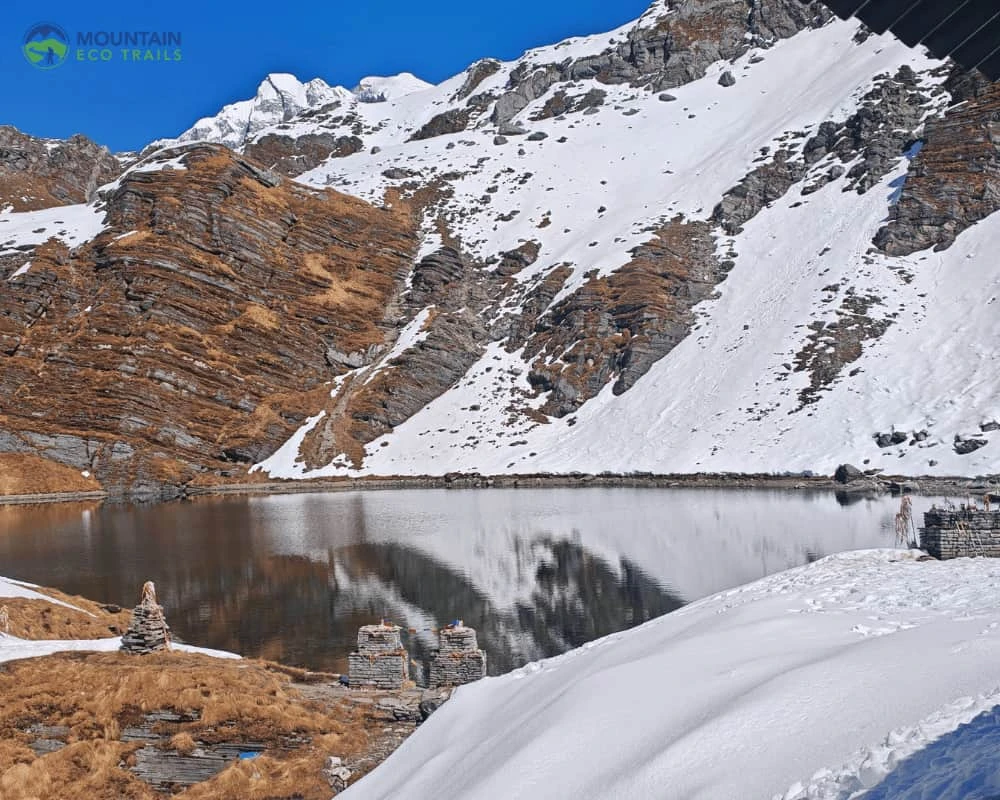
For strong and adequately acclimatised trekkers, Khayer Lake is one of the most adventurous parts of the itinerary. The lake sits at approximately 4,660 meters, about 1,000 meters above Khopra Ridge.

The hike involves a long climb through remote, exposed mountain terrain. It is physically demanding and should not be treated like a casual morning walk.

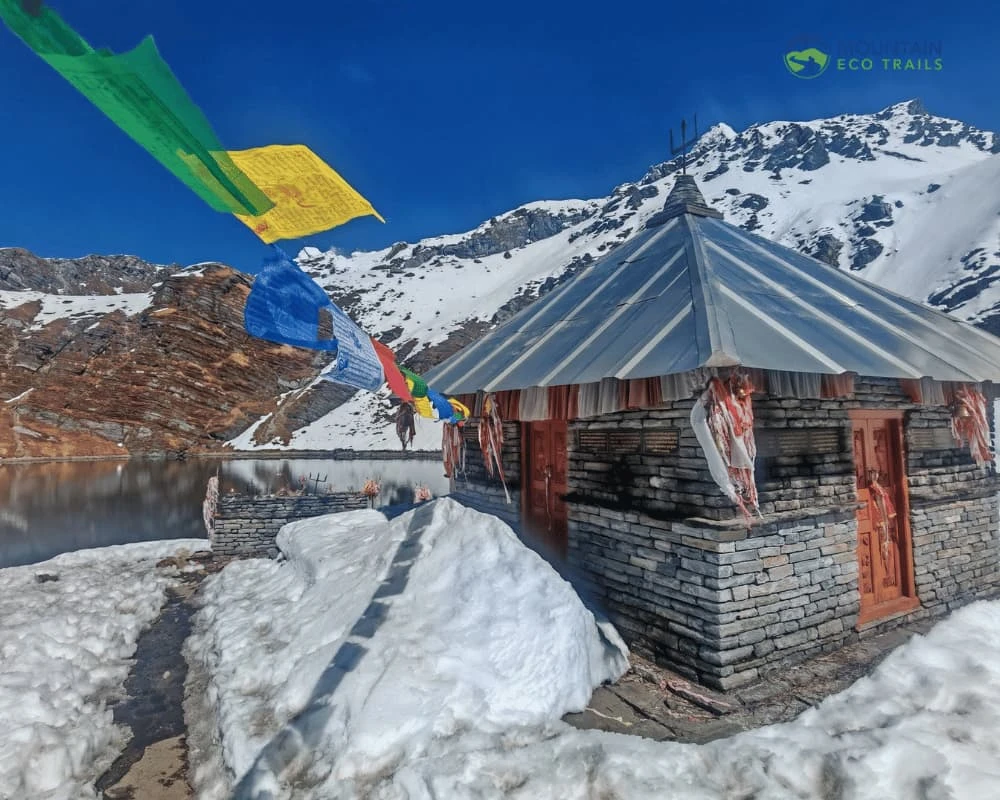
You need to start early, carry warm clothing, sufficient drinking water, food, and emergency essentials, and follow your guide's safety decisions. The trail leads toward a high mountain lake considered sacred by local Hindu communities.

Weather can change quickly, and snow or ice may make the route unsuitable at certain times. After visiting the lake, return to Khopra Ridge for a second overnight stay.

  • Max Altitude:4660 meters
  • Accommodation:Teahouse
  • Time:9-10 Hours
  • Meals:Breakfast, Lunch, Dinner

After two nights near Khopra Ridge, the journey continues toward Bayeli Kharka. This section is shorter than the previous day's optional lake hike and gives you an opportunity to enjoy the landscape at a slower pace.

The trail follows high slopes with views toward surrounding valleys and mountain ridges.

In good weather, distant Himalayan peaks remain visible during parts of the walk. Because the route is less frequently travelled than Ghorepani or Annapurna Base Camp, accommodation options are relatively limited.

Bayeli is a small mountain settlement known for its community-lodge experience. The facilities are simple, but the setting is rewarding for travellers who enjoy spending time away from busy trekking villages.

If the weather is clear, the afternoon can be spent watching the changing mountain light or taking short walks close to the lodge.

  • Max Altitude:3450 meters
  • Accommodation:Teahouse
  • Time:4-5 hours
  • Meals:Breakfast, Lunch, Dinner

From Bayeli, trek through lush forests and descend steadily. You’ll pass through a locality called Dobato (3420 m) – if you didn’t stay there, perhaps stop for tea. Near Dobato, a 15-minute side hike can take you to Muldai Viewpoint (3637 m), which offers another panorama. Continue the trail, which gently undulates through rhododendron and oak woods, with occasional clearings that frame Annapurna South and Machhapuchhre.

By early afternoon, reach Tadapani (2,620 m), a popular junction for trekkers coming from Ghorepani or going to ABC. 

  • Max Altitude:2620 meters
  • Accommodation:Teahouse
  • Time:5-6 Hours
  • Meals:Breakfast, Lunch, Dinner

 After breakfast, start descending from Tadapani to Ghandruk. The trail drops pretty steeply at first through thick forests. As you lose elevation, the climate gets warmer and the foliage more subtropical. After about 2–3 hours, you’ll notice more signs of habitation – terraces, buffalo sheds – and soon come to Ghandruk.

Ghandruk (1,940 m) is one of the largest Gurung villages in the region, with slate-roofed houses clustered on the hillside. It’s worth wandering a bit to see the traditional architecture and maybe the local museum that showcases Gurung culture. You’ll also have a stunning perspective of Machhapuchhre’s fishtail shape and Annapurna South from the village one last time.

From Ghandruk, you’ll take a jeep or bus back to Pokhara. The jeep ride from Ghandruk to Nayapul (or direct to Pokhara) is bumpy but scenic – about 2 hours to Nayapul on dirt roads. From Nayapul, it’s another 1.5 hours on a paved road to Pokhara. Overnight in Pokhara (hotel).

  • Max Altitude:827 meters
  • Accommodation:3-Star hotel
  • Time:5-6 Hours
  • Meals:Breakfast & Lunch

After an unforgettable trek, it’s time to return to Nepal’s capital. Board a tourist bus in the morning for the journey back to Kathmandu, retracing the route along rivers and hills. (Alternatively, you could opt for a 30-minute flight to Kathmandu if you prefer a quicker return – cost is higher, but you get more time in Kathmandu that day.)

Upon reaching Kathmandu, you can do some souvenir shopping or just relax at your hotel. The contrast of the bustling city after days in the tranquil mountains can be quite striking – you’ll likely be mentally replaying the trek as you dodge traffic and crowds again. Use the evening to perhaps meet up with fellow trekkers for a farewell dinner, sampling Nepali cuisine and maybe even some cultural music and dance.

    Got a question about this tour?

    Or looking for customize trip, reach out to our travel experts.

    Cost Includes
    • Kathmandu-Pokhara-Kathmandu Tourist Bus Fare
    • Pokhara to Birethanti Private Car. 
    • Ghandruk to Pokhara Sharing Jeep Costs.
    • Trekkers Information Management System permits cards.
    • Annapurna Conservation Area Project Permit card.
    • 2-night accommodation in Pokhara with Breakfast before and after the trek.
    • Government-licensed guide for 10 Days, including his salary, accommodations, and meals.
    • Meals during the trek include breakfast, lunch, and dinner.
    • Accommodations during the trek on a sharing basis. 
    • Seasonal fruits every day after dinner during the trek. 
    • First Aid Carried by the guide 
    • Arrangement of the Rescue Operation if needed. 
    • Farewell Dinner after the trek before the departure. 
    • Government and Local Taxes
    Cost Excludes
    • Personal expenses throughout the trip, like drinks, souvenirs, etc.
    • Porters (if needed; it costs 22 USD per day)
    • Emergency rescue evacuation, if needed.
    • Tips for the Guide.
    • Extra days in the mountains due to weather changes or any other unforeseen conditions. 
    • Extra 3.5% Bank charges if payment is made by card. 
    Availability
    Select a Departure Month
    Start DateEnd DatePriceStatus 
    Start DateStarts: SundayNov 08, 2026End DateEnds: TuesdayNov 17, 2026PricePriceUS$849StatusStatusAvailable
    Start DateStarts: SundayNov 15, 2026End DateEnds: TuesdayNov 24, 2026PricePriceUS$849StatusStatusAvailable
    Start DateStarts: SundayNov 22, 2026End DateEnds: TuesdayDec 01, 2026PricePriceUS$849StatusStatusAvailable
    Start DateStarts: SundayNov 29, 2026End DateEnds: TuesdayDec 08, 2026PricePriceUS$849StatusStatusAvailable
    Good to Know

    Can You Do the Khopra Danda Trek From Pokhara?

    Yes. Travellers already staying in Pokhara can start the Khopra Danda Trek directly from the city without including Kathmandu transportation days. Our standard 10-day package includes the journey from Kathmandu to Pokhara and back.

    If you are already in Pokhara, we can discuss a shorter itinerary focused on the trekking portion. The number of days depends on your route, walking pace, and whether you want to include Poon Hill and Khayer Lake.

    Khopra Danda Trek Difficulty: Is It Suitable for Beginners?

    The Khopra Danda Trek difficulty is moderate, but the route is not flat or effortless.

    Fit beginners can complete the main trek with suitable preparation, realistic daily pacing, and appropriate guide support. The biggest physical challenges are the stone staircases toward Ulleri, the ascent from Swanta to Khopra, repeated descents, and walking at elevations above 3,000 meters.

    Khayer Lake is a separate, more demanding challenge.

    What Makes the Trek Challenging?

    Steep uphill sections

    The ascent to Ulleri involves a substantial staircase climb. The approach to Khopra Ridge also requires sustained uphill walking. These sections can be tiring even for people who regularly exercise.

    Repeated walking days

    A single five-hour hike may feel easy at home. Walking for several consecutive days is different. Muscles need to recover overnight before another ascent or descent the following morning.

    High altitude

    Khopra Ridge is located at approximately 3,660 meters. At this height, the air contains less available oxygen than at sea level. Some trekkers may experience headaches, reduced appetite, or unusual fatigue.

    Basic accommodation

    The higher lodges have fewer facilities than city hotels. Cold bedrooms, shared bathrooms, and limited charging options can make the experience less comfortable for some travellers.

    The optional Khayer Lake excursion

    The lake hike reaches around 4,660 meters and may require nine to ten hours of walking. It is considerably harder than the main ridge walk.

    Can a First-Time Trekker Complete Khopra Danda?

    Yes, a first-time Himalayan trekker may be able to complete the main route. However, we recommend having some prior experience with long hill walks, stair climbing, or multi-day hiking.

    If you can comfortably walk uphill for four to six hours with a light backpack and recover well for the next day, you have a useful fitness foundation.

    How to Prepare for Khopra Danda Trek

    Start preparing approximately six to eight weeks before departure if you are not already hiking regularly.

    Weeks 1–2: Build consistency

    Walk three to four times per week. Add gentle slopes and gradually increase your walking distance.

    Weeks 3–4: Introduce climbs

    Include stair climbing, hill walking, or incline treadmill sessions.

    Practice carrying a small daypack.

    Weeks 5–6: Increase endurance

    Try longer hikes of four to five hours. Include uphill and downhill terrain.

    Add basic leg-strength exercises, particularly step-ups and controlled squats.

    Weeks 7–8: Practice consecutive hiking days

    If possible, complete two moderate hikes on consecutive days.

    This helps you understand how your legs respond to repeated walking. Training improves your strength and endurance, but it does not make you immune to altitude illness.

    Khopra Danda Trek vs Poon Hill

    Factor

    Khopra Danda Trek

    Poon Hill Trek

    Trail feel

    Quieter, more offbeat

    More popular and busier

    Main reward

    Ridge stay, broad mountain panorama, optional Khayer Lake

    Short sunrise viewpoint

    Difficulty

    Moderate

    Easier to moderate

    Ideal trip length

    Around 6–10 days, depending on the version

    Often shorter

    Best for

    Travellers wanting a fuller trekking experience

    Travellers wanting a shorter classic trek

    If someone wants a quick classic sunrise trek, Poon Hill is often enough. If someone wants a more immersive and less crowded route with a stronger offbeat appeal, Khopra Danda is the better fit. 

    Trekking Permit for Khopra Danda Trek 10 Days 

    For the Khopra Danda Trek, you’ll need to secure two permits:

    Annapurna Conservation Area Permit (ACAP): The cost is NPR 3,000 (approx USD 25–30) for foreign nationals (SAARC country citizens pay NPR 1,000).

    Trekkers’ Information Management System (TIMS) Card: As of recent regulations, the TIMS card costs USD 20 (NPR 2500) per person for individual trekkers, or $10 (NPR 1,000) if you are in a group with a guide (the idea being guided trekkers are already “managed”).

    Khopra Danda Trek route

    The Khopra Danda Trek generally follows an Annapurna foothill route that connects classic village areas with quieter ridge sections. On Mountain Eco Trails, the trip starts around Birethanti and ends around Ghandruk, while also highlighting Poon Hill, Swanta, Chistibung, Khopra Danda, and optional Khayer Lake as major route points.

    Main places on the route

    • Pokhara
    • Birethanti
    • Ghorepani / Poon Hill sector
    • Swanta
    • Chistibung
    • Khopra Danda
    • Khayer Lake
    • Ghandruk

    Best Time for Khopra Danda Trek

    The best time for the Khopra Danda Trek is generally spring (March to May) and autumn (October to November). Spring is especially attractive for rhododendron forests, while autumn often provides clearer post-monsoon mountain views. Winter trekking can be rewarding in suitable conditions, but cold temperatures and snow may limit access to higher sections.

    Khopra Danda Trek by Season

    easonMonthsMain advantagesMain considerations
    SpringMarch–MayRhododendron flowers, pleasant lower-trail temperaturesAfternoon clouds, variable mountain visibility
    MonsoonJune–SeptemberGreen landscapes, fewer trekkersRain, slippery trails, leeches, road disruption, landslide risk
    AutumnOctober–NovemberOften clearer mountain views and favourable walking conditionsPopular trekking period; lodge availability should be checked
    WinterDecember–FebruaryQuiet trails and potentially clear skiesCold nights, snow, ice, limited high-route access

    Spring: Rhododendrons and Changing Mountain Views

    Spring brings a distinct atmosphere to the Annapurna foothills. The forest between Ulleri and Ghorepani can be particularly attractive when rhododendrons bloom.

    Lower elevations are often comfortable for walking, although the higher ridge remains cold. Visibility may be best in the morning before clouds build around the mountains. April is a good option for travellers who want forest scenery as well as Himalayan views.

    Autumn: A Strong Season for Mountain Photography

    October and November are popular months for trekking in Nepal. After the monsoon, the landscape is often greener, and the mountains may appear especially sharp against clear skies.

    Morning views from Poon Hill, Khopra Ridge, and other viewpoints can be rewarding. However, clear weather is never guaranteed.

    Autumn also brings more trekking activity around Ghorepani and Ghandruk, although the Khopra section generally remains quieter than the main Annapurna routes.

    Winter: Beautiful but More Demanding

    December, January, and February can offer excellent visibility during stable weather. However, Khopra Ridge sits well above 3,000 meters, and overnight temperatures may fall below freezing.

    Snow and ice can affect the trail, particularly toward Khayer Lake. Winter trekkers need reliable clothing, suitable footwear, flexible plans, and advice about current trail conditions.

    The Khayer Lake hike should never be assumed to be accessible throughout winter.

    Monsoon: Not the First Choice for Beginners

    The monsoon brings lush vegetation but also significant challenges. Heavy rainfall can make stone staircases slippery and forest trails muddy. Leeches may be common at lower elevations.

    Road travel can also be disrupted. For beginners planning their first Himalayan trek, spring or autumn is generally a more dependable choice.

    Accommodation on the Khopra Danda Trek

    The Khopra Danda Trek is not a luxury-lodge route. It is mostly a basic teahouse and community lodge trek, and that is part of its charm. You can expect to stay in the community lodges at Khopra Danda. The community accommodation is simple but comfortable, with extra charges often applying for hot water, electricity, and Wi-Fi.

    Meals on the Khopra Danda Trek

    Meals on Khopra Danda routes are usually simple, filling, and trek-friendly. Competing Khopra pages commonly include breakfast, lunch, and dinner in package pricing or at least explain that meals are a major cost component. Typical lodge menus include Nepali meals, soups, noodles, rice dishes, eggs, potatoes, pancakes, tea, and coffee.

    Altitude Sickness and Safety on the Khopra Danda Trek

    Altitude is one of the main considerations when planning this trek. Although Khopra Danda is lower than Everest Base Camp, it is still high enough for altitude illness to occur.

    The standard itinerary reaches 2,874 meters at Ghorepani, descends to Swanta at 2,270 meters, and then climbs to Khopra Ridge at 3,660 meters for the next overnight stay.

    That substantial increase between Swanta and Khopra deserves careful attention.

    Why the Sleeping Altitude Matters

    Altitude illness risk depends partly on how quickly you gain sleeping elevation.

    General altitude-medicine guidance recommends gradual ascent and avoiding excessive sleeping-altitude gains above approximately 3,000 meters.

    The standard Swanta-to-Khopra day is more aggressive than usual conservative acclimatization guidance. For travellers without previous altitude exposure, adding an intermediate night or otherwise modifying the ascent deserves consideration.

    An extra night at Khopra does not automatically remove the risk associated with climbing too quickly to reach it.

    Symptoms You Should Not Ignore

    Common early symptoms of acute mountain sickness can include:

    • Headache.
    • Nausea or loss of appetite.
    • Dizziness.
    • Unusual tiredness.
    • Disturbed sleep.

    Inform your guide promptly if symptoms develop.

    Do not continue ascending to sleep higher while experiencing altitude-illness symptoms.

    Worsening symptoms call for appropriate descent and medical evaluation. Severe breathing difficulty, confusion, or loss of coordination are emergency warning signs.

    What About the Khayer Lake Hike?

    Khayer Lake reaches approximately 4,660 meters.

    Even though you return to Khopra Ridge to sleep, the high point of the day presents additional exposure to altitude, cold, and physical exertion. Your decision should be based on adequate acclimatisation, current symptoms, physical condition, and weather.

    We recommend that travellers with medical concerns seek advice from a qualified healthcare professional experienced in high-altitude travel before departure.

    No guide, itinerary, or level of fitness can guarantee that altitude sickness will not occur.

    Khopra Ridge vs Khayer Lake: Which Is Right for You?

    One of the most important things to understand before booking is that Khopra Danda and Khayer Lake are not the same destination.

    Khopra Danda, also called Khopra Ridge, is the main trekking destination and overnight location. Khayer Lake is an optional high-altitude excursion from Khopra.

    FeatureKhopra RidgeKhayer Lake
    Approximate altitude3,660 m4,660 m
    Role in the trekMain destinationOptional side excursion
    AccommodationCommunity lodge/teahouseReturn to Khopra for overnight stay
    DifficultyModerate overall, with a steep approachStrenuous high-altitude day hike
    Main attractionAnnapurna and Dhaulagiri mountain viewsSacred alpine lake and remote high-mountain landscape
    Suitable forPrepared beginners and intermediate trekkersStronger, appropriately acclimatised hikers
    Typical experienceRidge views, sunrise, overnight stayLong ascent and descent in one day

    When Should You Skip Khayer Lake?

    The lake excursion is optional for a reason.

    Consider skipping it if you experience altitude-related symptoms, feel unusually exhausted, have insufficient acclimatisation, or encounter unfavourable weather.

    Snow, ice, poor visibility, and strong winds can make the route more difficult. You should also avoid attempting the hike solely because other members of your group are doing it.

    Your mountain experience should match your own fitness and condition. Khopra Ridge already provides excellent Himalayan scenery, so skipping the lake does not make the main trek incomplete.

    Book Khopra Danda Trek Today

    Mountain Eco Trails organises only private treks or groups of private treks, like families and friends. It allows you to experience the journey privately and solely. We do not add you to random groups, which may create difficulties along the trail.

    Booking is very easy and safe with us. Mountain Eco Trails is a member of the Trekking Agency Association Nepal and a government-registered company. So, book your trek with us confidently. For trip confirmation, we request our clients to make a 10% advance payment of the total 10-Day Khopra Danda Trek Cost. The rest of the payment, you can do once you arrive in Kathmandu. For more information about the trek, you can contact us or directly book through WhatsApp as well (+9779849790153)

    More info:

    FAQs
    • The Khopra Danda Trek is a scenic trekking route in Nepal’s Annapurna region that leads to Khopra Ridge, a quieter viewpoint with wide mountain panoramas. It is known for community lodges, fewer crowds, and the optional hike to Khayer Lake.

    • Yes, fit beginners can do the Khopra Danda, especially if they have practised hill walking and stair climbing. However, the trek is not an easy walk, and its altitude requires careful planning. Beginners may prefer to skip Khayer Lake and discuss a more gradual ascent itinerary.

    • The cost depends on the package and group size. Generally, a full-board guided trek of 11–12 days (with permits, transport, guide, porter, meals, lodging included) ranges roughly $700–$1000 per person.

    • Compared with bigger Annapurna routes, Khopra Danda is less crowded and more peaceful. It is a quieter alternative to the Ghorepani Poon Hill Trek or ABC Trek.

    • Yes, you need a guide for the Khopra Danda Trek. A guide is highly recommended, especially for first-time trekkers. A guide helps with route pacing, lodge coordination, local communication, daily logistics, and confidence on the trail.

    • Yes. You need an Annapurna Conservation Area Permit (ACAP) and a TIMS (Trekkers’ Information Management System) card. ACAP costs around NPR 3,000 (~ USD 25–30) and TIMS is NPR 1,000–2,000, depending on group or individual status.

    • Khopra Danda is known for its wide views of the Annapurna and Dhaulagiri ranges. Mountain Eco Trails highlights peaks such as Annapurna, Dhaulagiri, Nilgiri, and Hiunchuli.

    • Accommodation is basic but generally comfortable enough for trekkers who expect simple mountain lodging. The route is known for teahouses and community lodges rather than luxury properties. However, extras like charging, hot showers, and Wi-Fi may cost more.

    • While the Khopra Danda Trek is not extremely high, altitude sickness (AMS) can occur above 2,800 m. Khopra Ridge at 3,660 m is our sleeping altitude high point. Our itinerary is designed to acclimatize you gradually (with a stop at Ghorepani 2,874 m before ascending). Most trekkers do fine by following standard precautions: hike slowly, stay hydrated, avoid alcohol, and spend extra nights if needed.

    • March to May and October to November are generally the best times for Khopra Danda. Spring offers flowering rhododendrons and pleasant lower-trail conditions, while autumn often provides clearer mountain views. Winter may bring snow and freezing temperatures, especially around the ridge and Khayer Lake.

    • Temperatures vary widely with altitude and season. In Autumn and Spring, daytime highs can be 15–20°C at lower elevations, and 5–10°C at Khopra. Nighttime can drop to freezing (0°C or a bit below) at Khopra Danda in autumn/spring, and much colder (-10°C or less) in winter nights. Gear: You’ll need to dress in layers. Essential items: a warm down or synthetic jacket, a fleece, thermal base layers, good waterproof/windproof jacket, trekking pants, a hat, gloves, a sun hat, and quality trekking boots. A sleeping bag rated to at least -10°C is important (especially if you trek in colder months). Trekking poles are highly recommended for steep sections. Don’t forget sunglasses, sunscreen, and a headlamp. We provide a detailed packing list to our clients, and you can rent gear in Pokhara if needed.

    • The Khopra Danda Trek needs at least 8-10 days, depending on the side trips. Mountain Eco Trails offers a 10-day Khopra Danda Trek from Kathmandu to Kathmandu, including transportation days and the optional Khayer Lake excursion. Shorter itineraries can begin in Pokhara, but the appropriate duration depends on your walking pace, route choices, and safe acclimatization requirements.

    • The trek typically starts and ends at Nayapul/Birethanti (about 1–2 hour drive from Pokhara). To reach Pokhara, most take a tourist bus from Kathmandu (7 hours) or a 30-minute domestic flight. Mountain Eco Trails will arrange your Kathmandu-Pokhara transfer as per your preference. Once in Pokhara, on the starting day we drive you to the trailhead by private vehicle (car or van). At the end of the trek, from Ghandruk or Nayapul we’ll pick you up and drive back to Pokhara.

    • The Khopra Danda Trek is moderately difficult because it involves steep climbs, stone staircases, repeated walking days, and sleeping at approximately 3,660 meters. Fit beginners can manage the main route with suitable preparation and acclimatization planning.

    SimilarTrips
    You may also like
    Did not find what you are looking for? No worries!

    Let us help you plan your perfect holiday.