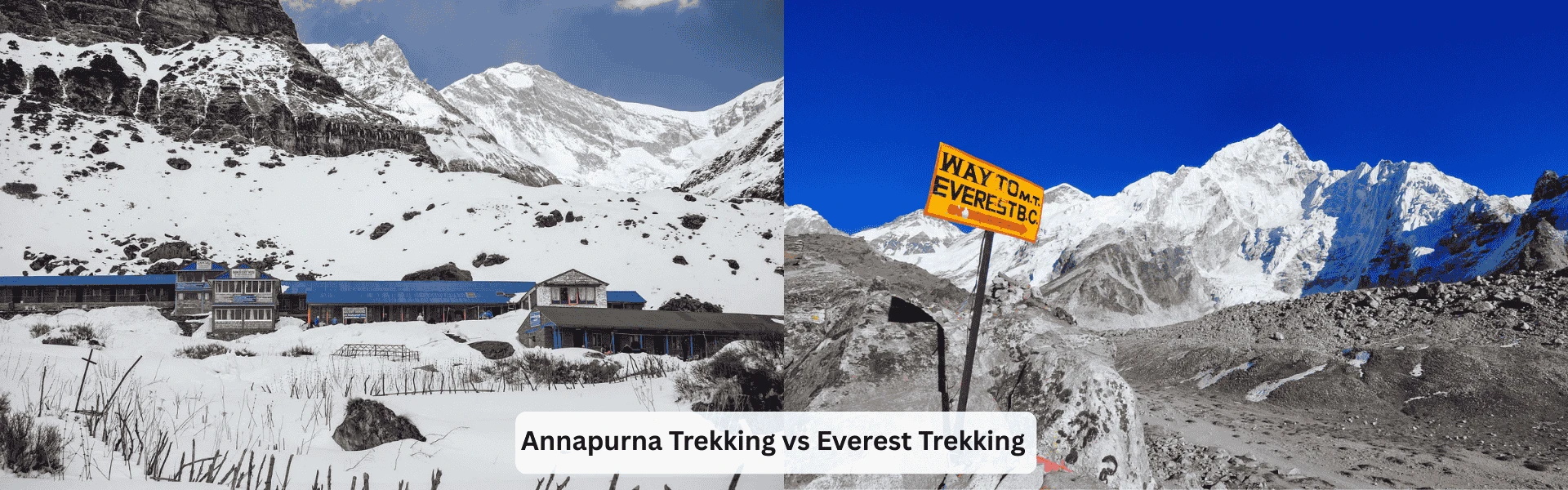
When planning a Himalayan adventure, many trekkers find themselves debating the Annapurna vs Everest trekking. Both regions in Nepal offer world-class treks, stunning mountain vistas, and rich cultural experiences. Yet, there are key differences in altitude, difficulty, cost, and overall experience that might make one trek more suitable for you than the other. In this comprehensive guide, we’ll compare the Everest region vs Annapurna region trekking experience across various factors to help you decide Everest or Annapurna, which is better for your next trip. Let’s dive in!
Annapurna vs Everest Trekking, Which is better?
Everest vs Annapurna Trekking: Overview
Everest Vs Annapurna Trekking are Nepal’s two most iconic trekking destinations. The Everest Trekking is world-famous, leading you through the Khumbu Valley to the foot of Mount Everest.
In contrast, the Annapurna region offers several treks, notably the Annapurna Circuit Trek and the Annapurna Base Camp Trek. Each has its unique highlights:
Everest Trekking: Roughly 5–20 days of trekking, starting with a dramatic flight to Lukla. You’ll trek among towering peaks like Everest, Lhotse, and Ama Dablam, and experience Sherpa culture in villages like Namche Bazaar and Tengboche. The trekking days depends if you are doing the Everest View Trek, the Three Passes Trek, or the EBC Trek.
Annapurna Trekking: Historically 18+ days for the full circuit (160–230 km), though many trekkers now do a shortened 12–15 day version. Apart from the circuit, there are several treks in Annapurna such as Poon Hill Trek, ABC Trek, Mardi Himal Trekking, Mohare Danda Trek, etc.
In short, Everest trekking is about reaching the world’s highest base camp amid legendary mountains, while Annapurna trekking offers diverse scenery and a slightly milder adventure.
Both are unforgettable – the choice comes down to your preferences. Below, we compare specific aspects of the Everest vs Annapurna trekking to guide your decision.
Altitude & Acclimatisation Differences of Annapurna & Everest
One of the biggest differences between the Everest and Annapurna treks is the altitude. Higher altitude means thinner air and a greater risk of Acute Mountain Sickness (AMS), so acclimatisation strategies are crucial.
Factor | Everest Trekking | Annapurna Trekking |
Max Elevation | 5,364 m (EBC) / 5,545 m (Kala Patthar) | 4,130 m (ABC) / 5,416 m (Thorong La) |
Time Above 5,000 m | Several days on Three High Passes Trek | Very limited (only the Thorong La crossing) |
Key Acclimatisation Stops | Namche (3,440 m), Dingboche (4,350 m) | Manang (3,500 m), pre-Thorong La |
Typical Acclimatisation Days | 1–2 full rest days | 1–2 days (ABC often none) |
AMS Risk Level | Higher due to altitude & duration | Moderate to lower overall |
Oxygen at the Highest Point | 50% of sea level (EBC) | 60% of sea level (ABC) |
Beginner-Friendly? | Challenging for first-timers | More suitable for first-time trekkers |
Acclimatisation is key in both treks. Both regions require smart pacing, hydration, and awareness of AMS symptoms. However, many trekkers guided by Mountain Eco Trails choose Annapurna first to build confidence before stepping into Everest’s extreme altitude zone.
Crowds & Trekking Experience of Annapurna vs Everest Trekking
Trail Traffic and Crowds in Annapurna Trekking & Everest Trekking
The Everest Trekking sees heavy foot traffic in peak seasons, especially along the EBC Trek Route. During autumn and spring, you’ll be sharing the path with hundreds of other trekkers, yak caravans, porters, and expedition crews. However, in Everest Trekking, routes like the Three Passes Trek sees less trekkers than the standard Everest Base Camp Trek.
Annapurna treks, while also popular, tend to be less crowded than Everest. The Annapurna region has multiple route variations. Beginners do treks like Ghorepani Poon Hill, Mardi Himal, etc. While experienced trekkers do the Annapurna Circuit Trek, ABC Trek, etc. With several trekking variation trekkers are dispersed.
Scenery & Culture of Annapurna Trekking vs Everest Trekking
Culturally, the experiences differ: the Everest region is the homeland of the Sherpa people, with Tibetan Buddhist culture on full display. You’ll visit monasteries, see prayer wheels, mani stones and colourful prayer flags, and maybe interact with climbers heading up Everest in season. The sense of being in a legendary mountaineering hotspot is palpable.
The Annapurna region is more culturally diverse – especially on the Circuit, you start among Hindu villages of Gurung and Magar people in lower elevations, transition to Buddhist-influenced areas in Manang, and even encounter a pilgrimage site (Muktinath) significant to both Hindus and Buddhists. Annapurna treks also feature lush forests, terraced fields, and a greater variety of landscapes than the more alpine-dominated Khumbu.
In terms of pure mountain views, the Everest trek offers more up-close wow moments with taller peaks. Annapurna treks offer diversity – you see high peaks too (Annapurna I,Dhaulagiri, Machapuchare), often from a bit more distance or unique angles, but also get waterfalls, green valleys, and even high desert plateau.
Everest vs Annapurna Trekking Cost Comparison
Cost is a deciding factor for many, and there are notable differences in the Everest vs Annapurna trekking cost.
Everest treks generally cost more, primarily because of the domestic flights and the higher prices in a remote region. Annapurna treks are comparatively budget-friendly, with some estimates suggesting ABC or Circuit can be done for half the cost of EBC if you go frugal. Consider what your budget is – if it’s tight, Annapurna might let you trek longer for less.
Either way, Mountain Eco Trails provides transparent cost breakdowns so you know exactly what’s included in your chosen package.
Cost Comparison Table: (Approximate costs in USD per person)
Expense Category | Everest Trekking | Annapurna Trekking |
Trek Package (avg) | $1,200 – $5,000 (higher end if including flights) | $500 – $2500 (group vs. private) |
Transport to Start | Flight to Lukla $450 round trip | Bus to Pokhara $15, or flight $100 (jeep to trail $100 split) |
Permits (total) | $50 (Sagarmatha + Khumbu Permit) | $50 (ACAP + TIMS) |
Teahouse Lodging | $8–$20 per night (higher at altitude) | $8–$15 per night (lower altitudes cheaper) |
Meals on Trek | $30–$40 per day (food cost rises with altitude) | 30–$35 per day (food slightly cheaper overall) |
Guide | $35-50/day | $30-40 /day |
Porter | $25/day | $22/day |
Key Extra | Lukla flight cost adds to the budget | No costly flights, saves money |
Note: These are rough estimates. Trek length, personal spending, and exchange rates will affect totals.
Which trek is harder, the Everest Trek or the Annapurna? Difficulty Comparison
In terms of difficulty, trekkers often ask: Which trek is harder, Everest Base Camp or Annapurna? The answer depends on what aspect of difficulty we consider – altitude, trail terrain, duration, and personal fitness all play a role. Here’s a breakdown:
- Everest Trekking is at a higher altitude for longer, which inherently makes it more demanding.
- The average Everest Trekking Duration in 12-20Days in comparison to Annapurna Trekking, which is 4-15 Days.
- The Everest Trekking trail involves several ascents and descents with high passes. Annapurna Trekking has a few high passes, but the trail is generally easy.
- Weather conditions on both the Everest Trekking & Annapurna Trekking can be unpredictable.
- Rescue evacuation is available on both the Everest and Annapurna Trekking. But it can be complicated during the peak season.
The Everest trekking is generally considered the hardest trek overall. The higher elevation, slightly longer duration at extreme altitudes, and rugged terrain. Many find the final days (Gorak Shep to EBC and the optional Kala Patthar climb) to be especially tough.
Whereas Annapurna Trekking has several easy and difficult-level trekking routes. It offers several varieties to beginners & experienced Trekkers.
At Mountain Eco Trails, we advise trekkers honestly about these challenges. With proper preparation – building up your hiking endurance, maybe some altitude training hikes, and choosing the right season – both treks are absolutely doable for the average fit person.
Annapurna or Everest trek for beginners, which is better?
If you’re relatively new to trekking, you might be asking: Should my first Nepal trek be in Annapurna or the Everest region? There’s no one-size-fits-all answer, but let’s consider a few points to determine which trek is better for beginners:
For a beginner, Trekking in the Annapurna Region, such as Ghorepani Poon Hill Trek, Ghorepani ABC trek, Short Mardi Himal Trek, etc. are recommended.
However, you can do the Everest View Trek or the Everest Panorama Trek as a beginner in the Everest Region. Many first-time trekkers complete the EBC Trek as well, but it requires more careful acclimatisation.
Bottom line for beginners: We’d rate the Annapurna Trekking as the best beginner-friendly trek among these, due to its moderate length and altitude. The Everest Trekking for beginners is achievable but will demand more grit and preparation – you should be ready for a tougher challenge.
No matter which you choose as a beginner, go in with a positive mindset, a reasonable training base, and choose a good trekking company like Mountain Eco Trails to support you.
FAQs
Which trek is harder, Everest Base Camp or Annapurna Circuit?
The Everest Base Camp trek is generally considered a bit harder due to the higher altitude and slightly longer time spent above 5,000 m.
What is the highest altitude on the Everest vs Annapurna treks?
Everest Base Camp itself is at 5,364 m (17,598 ft). Many trekkers also climb Kala Patthar (5,545 m) for views. On the Annapurna side, the Annapurna Circuit’s highest point is Thorong La Pass at 5,416 m (17,769 ft). So the Everest trek has a higher sustained altitude.
How long does it take to trek to Everest vs Annapurna?
The classic Everest Trekking takes about 12–20 days round-trip from Lukla. While Annapurna has varieties of short and long trek which takes 4-20 days.
Is the Everest trek more crowded than the Annapurna treks?
Yes, generally Everest is more crowded, especially during peak seasons (spring and autumn). The trail from Lukla to EBC is narrow, and all trekkers funnel through the same villages, so it can feel busy.
How much does the Everest trek cost vs Annapurna treks?
Trek costs vary, but expect to spend more for Everest. A typical guided EBC trek might cost $1,300–$2,000+. An equivalent length Annapurna Circuit or ABC trek could be $800–$1,500.
Which trek is better for beginners, Everest or Annapurna?
Annapurna treks are better for beginners in most cases. The Annapurna Base Camp trek is shorter and stays at a lower altitude (max 4,130 m), making it an excellent introductory high-mountain trek.
When is the best time to trek to Everest or Annapurna?
The best times for both the Everest and Annapurna treks are spring (March to May) and autumn (late September to November). These periods offer stable weather, clear mountain views, and moderate temperatures. For most trekkers, stick to spring or autumn for both regions – aligning with holiday times in the US, UK/EU, and Australia as well.
Do I need a guide for the Everest or Annapurna trekking?
As of 2023 Nepal requires at least a guide or porter for most trekking regions for safety. In practice, hiring a guide is highly recommended for both Everest and Annapurna treks – especially if you’re not experienced. A guide enhances safety (knows the route, watches for AMS symptoms, handles logistics) and enriches the experience by teaching you about local culture.
Conclusion: Annapurna vs Everest Trekking, which is better?
So, Annapurna vs Everest – which is better? The honest answer: it depends on you. Each trek has its own magic and challenges. Here’s a quick recap to help you decide:
- If you dream of witnessing the highest peak in the world or want a more adventurous trekking experience, then Everest Trekking is right for you.
- If you crave diverse landscapes and a slightly more relaxed adventure, an Annapurna trek might suit you better.
- Everest is more crowded in peak season. Annapurna is less crowded in terms of trekkers. So, choose wisely which one is better for you.
At Mountain Eco Trails, we often get asked, “Everest or Annapurna, which is better?” Our answer: You can’t really go wrong; both will leave you in awe.
In many ways, Annapurna vs Everest trekking is a friendly rivalry – but it’s not about which is objectively better, it’s about which is better for you.
If you are planning to do any of these treks, feel free to contact us via email or WhatsApp us at +9779849790153. We specialise in operating trekking & tours in Nepal.

Anil Lamsal
Call us on WhatsApp+977 9849790153OrChat with us