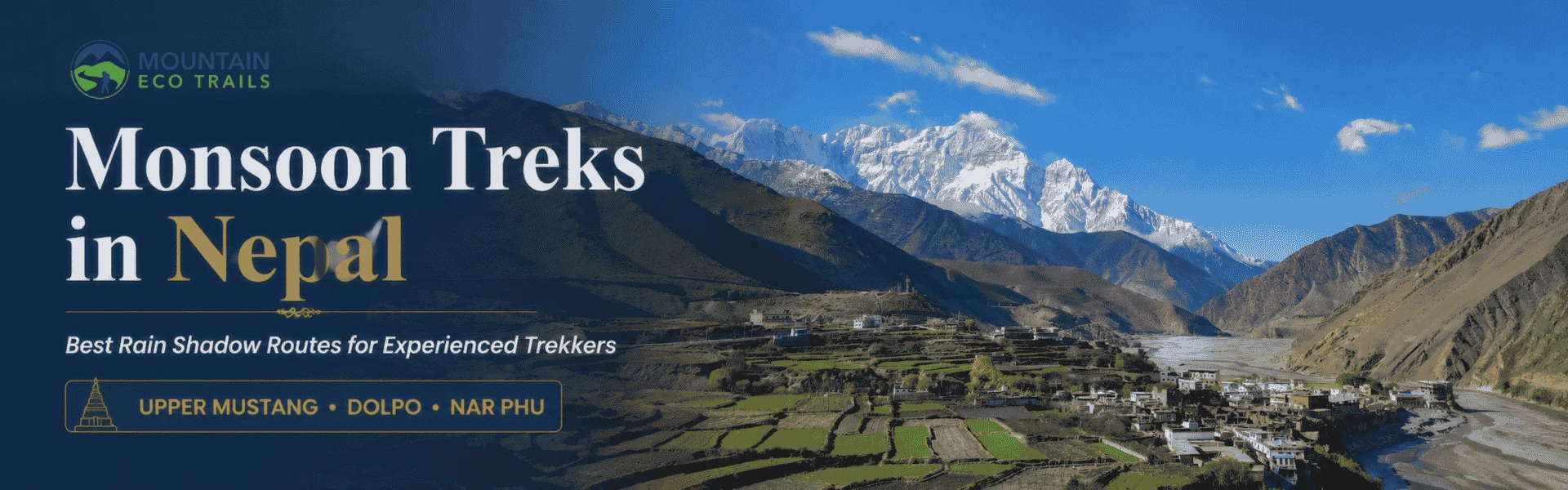
Monsoon Treks in Nepal are best for experienced trekkers who want quiet trails, wild landscapes, and smart route choices during June, July, August, and early September. The safest and most rewarding options are the rain shadow treks Nepal offers, such as Upper Mustang, Upper Dolpo, Lower Dolpo, Nar Phu Valley, and selected northern sections of the Annapurna Circuit. Classic routes like Everest Base Camp and Annapurna Base Camp are possible but often wetter, cloudier, and less reliable. For Seasoned trekkers with summer holidays, Upper Mustang is usually the strongest monsoon trekking option in Nepal.
Best Monsoon Treks to do in Nepal
Monsoon Treks in Nepal: Best Rain Shadow Routes of Nepal
Monsoon in Nepal scares many trekkers away. Rain, clouds, muddy trails, leeches, landslides, and flight delays are real concerns. But for seasoned trekkers, the monsoon season also opens a different side of the Himalayas.
This is when the classic trails become quiet. Villages feel more local. Valleys turn green. Waterfalls come alive. And if you choose the right region, you can still walk through dry, dramatic Himalayan landscapes while the lower hills receive heavy rain.
The secret is not to “avoid monsoon.” The secret is to understand Nepal’s geography.
The best monsoon treks in Nepal are not random trails. They are mostly rain shadow treks behind the high Himalayan wall, especially in Mustang, Dolpo, Nar Phu, and the northern Annapurna region. This guide is written for experienced European trekkers who want to use their June, July, or August holiday wisely.
What Are the Best Monsoon Treks in Nepal?
The best monsoon treks in Nepal are Upper Mustang, Upper Dolpo, Lower Dolpo, Nar Phu Valley, and parts of the Annapurna Circuit near Manang, Muktinath, and Mustang. These areas receive less rain than lower hill regions because they sit partly in the Himalayan rain shadow.
For most trekkers, Upper Mustang is the best overall monsoon trek because it is drier, culturally rich, logistically easier than Dolpo, and suitable for a 10–14-day itinerary.
Why Monsoon Trekking Nepal Is Different
Nepal’s monsoon usually runs from June to September. During this period, warm moisture from the south brings rainfall to many lower and middle hill regions.
That does not mean the whole country is wet in the same way.
Nepal has huge altitude and climate variation. A trail near Pokhara can be soaked, while Mustang beyond the Annapurna range can feel dry, windy, and desert-like. This is why route selection is everything during the monsoon.
Trekking in Nepal during the monsoon is best planned around rain shadow regions. Upper Mustang, Dolpo, Nar Phu, and northern Annapurna receive less rainfall than southern hills. These routes are better for experienced trekkers who can handle altitude, long walking days, basic lodges, flexible logistics, and changing weather.
What Are Rain Shadow Treks Nepal Is Known For?
Rain shadow treks in Nepal offers are routes located behind major Himalayan ranges. When monsoon clouds move north from the Indian plains, the high mountains block much of the moisture. The southern slopes receive more rain, while the northern valleys stay comparatively dry.
This is why Mustang and Dolpo are so important for monsoon trekking.
These regions feel different from green Nepal. Expect eroded cliffs, cave settlements, Tibetan Buddhist culture, wide river valleys, dry wind, old trade routes, and high-altitude desert scenery.
For seasoned trekkers, this is not a backup plan. It is a completely different Himalayan experience.
Best Monsoon Treks in Nepal: Route Comparison Table
Trek | Best For | Monsoon Suitability | Difficulty | Ideal Duration |
Upper Mustang Trek | Culture, dry landscapes, summer trekking | Excellent | Moderate to Challenging | 10–14 days |
Upper Dolpo Trek | Remote wilderness, serious adventure | Excellent but logistically harder | Challenging to Strenuous | 18–25 days |
Lower Dolpo Trek | Remote trails, Phoksundo Lake, fewer crowds | Good | Challenging | 14–18 days |
Nar Phu Valley Trek | Hidden valleys, rugged terrain, fewer trekkers | Good | Challenging | 10–14 days |
Annapurna Circuit Northern Section | High passes, Manang, Mustang side | Moderate to Good | Challenging | 12–16 days |
Everest Base Camp Trek | Famous route, high-altitude experience | Possible but not ideal | Challenging | 12–14 days |
Annapurna Base Camp Trek | Classic mountain sanctuary | Poor to Moderate | Moderate | 7–11 days |
1. Upper Mustang Trek: The Best Monsoon Trek in Nepal
Upper Mustang is the strongest choice for Nepal trekking in July and August. It lies north of the Annapurna and Dhaulagiri ranges, so it receives far less rain than the southern foothills.
The route follows the ancient salt trade corridor toward Lo Manthang, the old walled capital of Mustang. The landscape is dry, open, and cinematic. You walk past red cliffs, caves, whitewashed villages, chortens, mani walls, and monasteries that feel closer to Tibet than lowland Nepal.
For Seasoned trekkers with limited summer holidays, Upper Mustang works well because the route is culturally rich and less affected by daily rainfall than classic treks.
Best for: Experienced trekkers who want dry trails, Tibetan culture, photography, and a rare off-season Himalayan journey.
Watch out for: Restricted area permits, road sections, strong afternoon winds, and possible travel delays around Pokhara or Jomsom.
2. Upper Dolpo Trek: Remote, Wild, and Serious
Upper Dolpo is one of the finest monsoon treks in Nepal for serious trekkers. It is remote, high, raw, and deeply cultural. The region sits in western Nepal and includes high passes, ancient monasteries, yak pastures, and landscapes that feel untouched by mass tourism.
This trek is not for casual hikers. Distances are long. Facilities are basic. Logistics are more complex. Flights to western Nepal can be delayed. Some sections may require camping-style support depending on the itinerary.
But for seasoned trekkers, Upper Dolpo offers something rare: silence, space, and a true expedition feeling.
Best for: Strong trekkers who want remote trails, high passes, and a less commercial Himalayan route.
Watch out for: Cost, permits, long duration, flight delays, and limited rescue access.
3. Lower Dolpo Trek: Phoksundo Lake and Rain Shadow Beauty
Lower Dolpo is slightly more accessible than Upper Dolpo but still feels remote. The main highlight is Shey Phoksundo Lake, one of Nepal’s most beautiful high-altitude lakes.
During the monsoon, Lower Dolpo can be a smart choice for trekkers who want a less crowded route but do not want the full commitment of Upper Dolpo. The landscape is dry in many sections, but logistics still require flexibility.
This trek suits experienced walkers who are comfortable with altitude, basic accommodation, and changing transport plans.
Best for: Trekkers who want wilderness, lake scenery, and a remote western Nepal experience.
Watch out for: Flights, trail conditions, basic services, and longer emergency response times.
4. Nar Phu Valley Trek: A Hidden Monsoon Alternative
Nar Phu Valley is one of Nepal’s most underrated off-season trekking routes. It lies near the Annapurna region but feels far more isolated than the classic circuit.
The route enters narrow canyons, old stone villages, high pastures, and Tibetan Buddhist settlements. During monsoon, it can be a better option than greener lowland routes because parts of the trail sit in a drier trans-Himalayan zone.
Nar Phu is not as dry as Upper Mustang, but it is more adventurous than most standard trekking routes.
Best for: Experienced trekkers looking for a wild, less crowded alternative near Annapurna.
Watch out for: Landslide-prone approach sections, permit rules, altitude gain, and basic lodging.
5. Annapurna Circuit in Monsoon: Choose the Northern Side Carefully
The full Annapurna Circuit has mixed monsoon conditions. The lower sections near Besisahar, Chame, and forested valleys can be wet, slippery, and affected by landslides.
But the northern side around Manang, Thorong La, Muktinath, and Mustang sits closer to the rain shadow. This makes selected sections more suitable than the lower trail.
For the monsoon, the smartest strategy is not to sell the full circuit blindly. It is better to design a flexible itinerary around safer and drier sections.
Best for: Fit trekkers who want a high-pass experience with careful planning.
Watch out for: Road conditions, landslides in lower sections, Thorong La weather, and altitude risk.
Treks to Avoid or Think Twice About During Monsoon
Not every Nepal trek is a good monsoon idea. Some trails are beautiful in spring and autumn but become less reliable in rainy months.
Be careful with:
- Annapurna Base Camp Trek
- Ghorepani Poon Hill Trek
- Langtang Valley Trek
- Mardi Himal Trek
- Helambu Trek
- Lower forested trails around Pokhara
- Remote trails with poor landslide management
These routes can still be done in some cases, but they are often wet, cloudy, muddy, and leech-prone. Mountain views may be limited. Road access can also be affected by landslides.
The best monsoon trekking strategy in Nepal is to avoid low-altitude forest routes and choose drier trans-Himalayan regions. Mustang and Dolpo are stronger than Annapurna Base Camp, Mardi Himal, or Ghorepani during July and August because they receive less direct monsoon impact.
Nepal Trekking in July: What to Expect
July is one of the wettest months in much of Nepal. Lower trails can be humid, green, and slippery. Clouds often block mountain views in popular trekking regions.
But July can be excellent in Upper Mustang and Dolpo.
For Seasoned trekkers, July works best if you have:
- Flexible travel days
- Good rain protection
- A realistic attitude about the weather
- A route in a rain shadow region
- A licensed local guide
- Travel insurance that covers trekking at high altitudes
Do not plan a tight international departure immediately after a remote monsoon trek. Add buffer days.
Nepal Trekking in August: Is It Worth It?
August is still monsoon season, but it can be rewarding in the right region. Upper Mustang remains one of the best August trekking options. Dolpo is also possible for experienced trekkers with more time.
August is not the best month for classic clear mountain panoramas in the Everest or Annapurna foothills. But it is excellent for trekkers who want quiet trails, culture, and dramatic landscapes without peak-season crowds.
If your priority is dry weather and clear views every day, autumn is better. If your priority is solitude and a rare Himalayan atmosphere, August can be special.
Monsoon Trekking Safety Tips for Seasoned Trekkers
Monsoon trekking is not inherently dangerous. Poor planning is dangerous.
Use these rules:
- Choose rain shadow routes over forested lowland trails.
- Start walking early to avoid afternoon rain.
- Add 2–3 buffer days for flights and road delays.
- Avoid crossing landslide-prone sections in heavy rain.
- Carry waterproof layers and dry bags.
- Use trekking poles for muddy or loose trails.
- Trek with a licensed guide in restricted regions.
- Check trail conditions locally before departure.
- Buy insurance that covers altitude and evacuation.
- Do not force a high pass in poor visibility.
Experienced trekkers know that patience is part of mountain travel. In monsoon, patience is not optional.
Estimated Cost of Nepal Monsoon Trekking Packages
Costs vary by route, permit, group size, guide level, transport, and service quality.
Trek Package | Estimated Cost Range | Why Cost Varies |
Upper Mustang Trek | USD 1,700–2,800+ | Restricted permit, transport, guide, duration |
Upper Dolpo Trek | USD 3,500–6,000+ | Remote logistics, permits, camping/support |
Lower Dolpo Trek | USD 2,500–4,500+ | Flights, permits, guide, and remote services |
Nar Phu Valley Trek | USD 1,300–2,300+ | Restricted permit, guide, Annapurna access |
Annapurna Circuit Custom Monsoon Trek | USD 1,100–2,000+ | Route length, transport, guide, itinerary |
Tip: Do not choose a monsoon trek solely based on price. A cheaper package with poor logistics can cost more later through delays, missed flights, weak guiding, or unsafe route decisions.
Note: If you are looking for the best Monsoon Trekking Package in Nepal, contact us via Email or WhatsApp us at +977984979053.
What to Pack for Trekking in Nepal During Monsoon
Monsoon packing is not only about rain. It is about keeping your core gear dry.
Essential items:
- Waterproof jacket
- Rain pants
- Backpack rain cover
- Dry bags for clothes and electronics
- Quick-dry trekking shirts
- Lightweight fleece
- Strong trekking boots
- Spare socks
- Trekking poles
- Sun hat and sunglasses
- Water purification tablets or a filter
- Insect repellent for lower sections
- Basic first aid kit
- Power bank
- Travel insurance documents
For Upper Mustang and Dolpo, pack for both rain and dry high-altitude wind. These regions can feel hot in the sun, cold at night, and dusty in the afternoon.
Is Monsoon Trekking in Nepal Right for You?
Monsoon treks are not ideal for everyone.
They are right for you if:
- You have prior high-altitude trekking experience.
- You can handle flexible logistics.
- You prefer quiet trails over perfect weather.
- You want culture, landscapes, and solitude.
- You are comfortable with basic accommodation.
- You understand that mountain views are not guaranteed daily.
They may not be right for you if:
- This is your first trek in Nepal.
- You want guaranteed mountain views.
- You dislike rain, mud, or delays.
- You have a very tight return flight.
- You want luxury comfort throughout.
Monsoon Treks in Nepal are best for experienced trekkers, not first-time hikers. The top choices are Upper Mustang, Upper Dolpo, Lower Dolpo, Nar Phu Valley, and selected northern Annapurna sections. The safest plan includes flexible days, rain-shadow routing, licensed guides, proper permits, and strong travel insurance.
Why Book a Monsoon Trek With a Local Nepal Operator?
A monsoon trek needs local judgment. Weather apps are not enough in Nepal’s mountains. A good local operator like Mountain Eco Trails can help you choose the right route, adjust the itinerary, check road conditions, manage restricted area permits, arrange reliable guides, and build buffer days into your plan.
For European trekkers, this matters even more because most travel during fixed summer holidays. A smart itinerary can protect your time, money, and safety.
Planning a Monsoon Trek in Nepal?
Mountain Eco Trails organises guided monsoon trekking Nepal packages for experienced trekkers who want safe, flexible, and well-designed Himalayan journeys. If you are considering Upper Mustang, Dolpo, Nar Phu, or a custom rain-shadow trek, ask for a route plan based on your dates, fitness, and comfort level. You can email us or contact us directly at WhatsApp at +9779849790153.
FAQs: Monsoon Treks in Nepal
1. Can you trek in Nepal during the monsoon?
Yes, you can trek in Nepal during the monsoon if you choose the right region. Rain shadow areas like Upper Mustang, Dolpo, Nar Phu, and northern Annapurna are better than lower forested trails. Planning, guide support, waterproof gear, and buffer days are important.
2. What are the best monsoon treks in Nepal?
The best monsoon treks in Nepal are Upper Mustang, Upper Dolpo, Lower Dolpo, Nar Phu Valley, and selected northern sections of the Annapurna Circuit. These routes are better because they sit partly behind the Himalayas and receive less monsoon rainfall.
3. Is Upper Mustang good in July?
Yes, Upper Mustang is one of the best treks in Nepal in July. It lies in the rain shadow of Annapurna and Dhaulagiri, so it stays much drier than many classic trekking regions. It also offers Tibetan culture, caves, monasteries, and dramatic desert landscapes.
4. Is Nepal trekking in August worth it?
Nepal trekking in August is worth it if you choose rain-shadow routes and accept flexible mountain logistics. Upper Mustang and Dolpo are better options than Everest Base Camp or Annapurna Base Camp. August offers quiet trails, green valleys, and fewer trekkers.
5. Which Nepal trek has the least rain in the monsoon?
Upper Mustang usually has the least rain among popular Nepal trekking routes during the monsoon. Dolpo is another strong option for experienced trekkers. Both regions sit in trans-Himalayan areas where the high mountains block much of the monsoon moisture.
6. Is Everest Base Camp good during the monsoon?
Everest Base Camp is possible during the monsoon, but it is not the best choice. Trails can be wet, views are often cloudy, and Lukla flights may face delays. For European trekkers with limited summer holidays, Upper Mustang is usually a safer monsoon option.
7. Are monsoon treks in Nepal safe?
Monsoon treks in Nepal can be safe with the right route, guide, gear, and timing. The biggest risks are landslides, slippery trails, river crossings, flight delays, and poor visibility. Rain shadow routes reduce some weather risk but still need careful planning.
8. What is the best Nepal off-season trekking route?
Upper Mustang is one of the best Nepal off-season trekking routes, especially during June, July, and August. It is dry compared to many other regions, culturally rich, and suitable for experienced trekkers who want a quieter Himalayan experience outside peak season.
Conclusion
Monsoon trekking in Nepal is not about gambling with the weather. It is about reading the map correctly.
If you choose low forest trails, you may fight rain, mud, clouds, and leeches. If you choose rain shadow regions, you can experience a quieter, drier, and more culturally powerful side of the Himalayas.
For seasoned European trekkers, the best monsoon treks in Nepal are Upper Mustang, Upper Dolpo, Lower Dolpo, Nar Phu Valley, and carefully planned northern Annapurna routes.
The smartest choice for most travellers is Upper Mustang. It balances dry terrain, cultural depth, manageable logistics, and strong summer suitability.
If you want a monsoon trek that feels intentional rather than compromised, choose the route with local knowledge, flexible planning, and respect for the season.

Anil Lamsal
Call us on WhatsApp+977 9849790153OrChat with us