The Manaslu Circuit Trek has reopened after the October 11, 2026 flash flood damaged sections of the Budhi Gandaki Valley. Following repairs to trails, bridges, and access roads, trekking has resumed toward Larkya La Pass. Tsum Valley has also been reported reopened after local communities restored damaged crossings. But is the route completely safe, and what does the reopening mean for travellers planning the Manaslu Circuit Trek in 2027? Explore the latest route updates, affected sections, remaining safety concerns, and practical advice for planning your trek with confidence.
Manaslu Circuit Trek and Tsum Valley Re-Opens after Flash Flood
Manaslu Circuit Trek After Flash Flood: Is It Open and Safe for 2027?
The Manaslu Circuit Trek, after the flash flood of October 11, 2026, has reopened, with caution required along previously damaged trails. According to the Trekking Agencies' Association of Nepal (TAAN) advisory reported on October 25, trekking has resumed toward Larkya La Pass following repairs to roads, bridges, and walking trails.
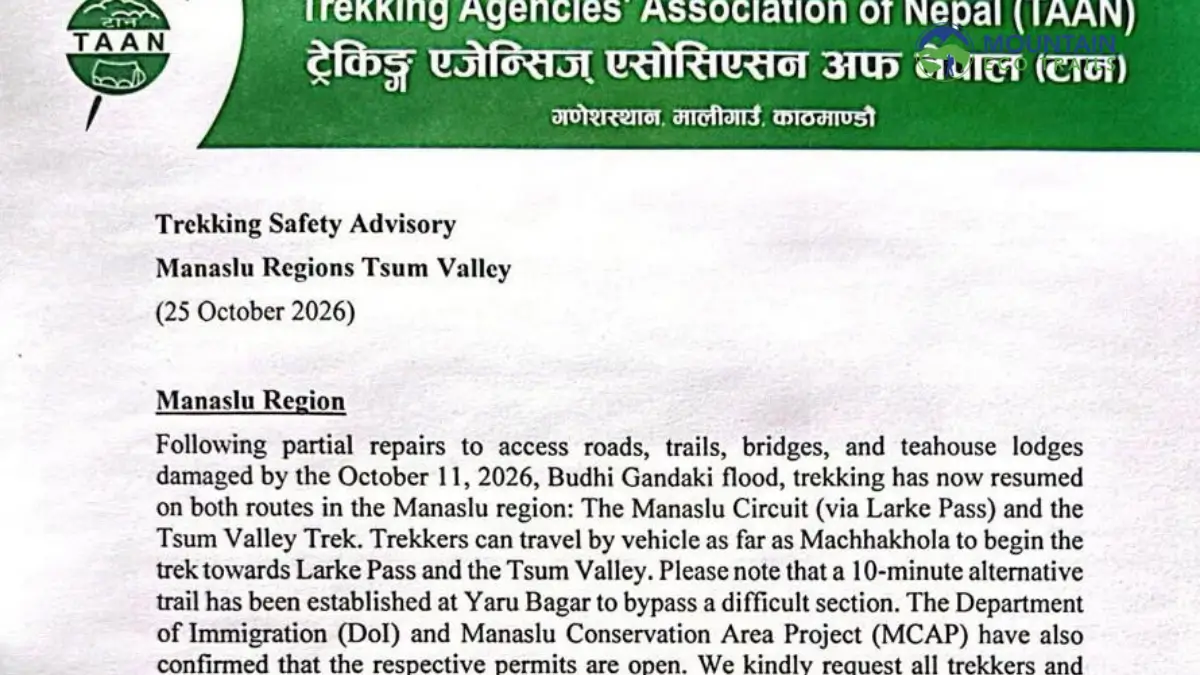
The Tsum Valley route has also been reported reopened after local communities installed temporary wooden bridges. However, reopening does not mean all infrastructure has been permanently restored. Trekkers planning the Manaslu Circuit Trek in 2027 should verify current route conditions, road access, accommodation, and weather before departure.
Introduction: What the Manaslu Flood Means for Trekkers
The Manaslu Circuit has always attracted trekkers who prefer quieter Himalayan trails, traditional mountain villages, and the challenge of crossing Larkya La Pass. But the October 2026 flash flood along the Budhi Gandaki River has raised an important question: Is the Manaslu Circuit Trek safe after the flood?
For travellers who have already booked flights to Nepal, this is more than a general question about trekking conditions. They want to know whether roads are accessible, bridges have been repaired, teahouses are operating, and the route is suitable for their planned departure.
The encouraging news is that trekking has resumed. Yet some damaged infrastructure remains dependent on temporary repairs and alternative paths.
This guide explains what happened, which sections were affected, what the latest reopening announcements mean, and how to plan the Manaslu Circuit or Tsum Valley Trek responsibly in 2027.
Is the Manaslu Circuit Trek Open After the Flood?
Yes. As of October 26, 2026, the Manaslu Circuit trekking route is operating again following the October 11 flood. TAAN has reported restored access from Machha Khola toward Jagat, Philim, Samagaon, and Larkya La. A short bypass is available at Yaru Bagar.
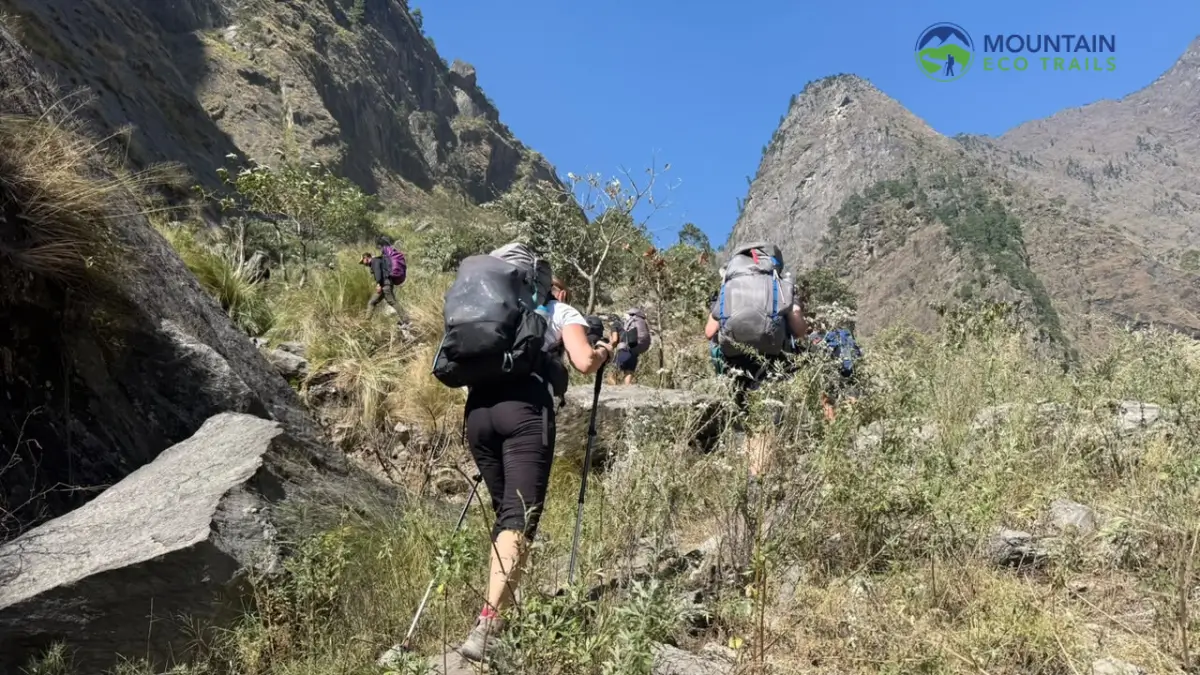
However, trekkers must exercise caution because some repairs are temporary
Manaslu Trek Flood Update: Current Route Status
Reported conditions as of October 25–26, 2026. These are not live trail inspections.
| Manaslu Circuit via Larkya La | Reopened; proceed cautiously |
| Machha Khola road access | Reported accessible by vehicle |
| Yaru Bagar | Alternative walking trail established |
| Jagat to Nubri Valley | Trekking resumed through repaired sections |
| Tsum Valley | Reopening reported October 25; verify temporary bridges |
| Trekking permits | Issuance reported available |
| 2027 trekking conditions | Cannot yet be confirmed |
Sources: October 25 reporting on TAAN's safety advisory and MCAP's field updates.
What Happened During the October 11, 2026 Manaslu Flash Flood?
On October 11, 2026, severe flooding along the Budhi Gandaki River damaged important sections of the trekking infrastructure in Gorkha District, Nepal.
The flood affected more than one isolated bridge. Sections of walking trail, suspension bridges, access roads, and local settlements along the lower Manaslu corridor suffered damage.
According to the Manaslu Conservation Area Project (MCAP), the affected locations included Soti, Khorlabesi, Tatopani, Yaru Bagar, Jagat Bagar, and Salleri. The cantilever bridge at Sardibhir, near the entrance to Tsum Valley, was also washed away, cutting off a vital connection.
Why was the flood particularly disruptive?
The lower Budhi Gandaki Valley is the main approach for most standard Manaslu Circuit itineraries.
Even when trails around Samagaon or the approach to Larkya La remain passable, trekkers still need a safe way to reach those areas.
That is what made this incident particularly concerning: damage to a relatively small number of critical access points interrupted travel across a much larger trekking region.
The consequences extended beyond tourism. Residents also depend on these paths and bridges to move food, household supplies, and other essential goods between villages.
Timeline: From Flood Damage to Trekking Resumption
Date | Reported development |
|---|---|
October 11, 2026 | Budhi Gandaki flooding damages trails, roads, and bridges. |
October 12 | MCAP reports extensive damage and advises against travel into Tsum Valley. |
October 16 | Visitors begin returning through the Manaslu Conservation Area's Jagat checkpoint. |
October 22–23 | TAAN reports partial resumption of the Manaslu Larkya La route and announces the Yaru Bagar bypass. |
October 25, morning | MCAP reporting indicates the circuit is accessible, while Tsum Valley repairs remain incomplete. |
October 25, later reports | TAAN's updated advisory reports that both the circuit and Tsum Valley are operating following additional community repairs. |
The timeline explains why travellers may encounter apparently contradictory articles online. Reports published before the latest repair work correctly described closures at that time, but they should not automatically be treated as the current status.
Manaslu Circuit Trek Route Update After the Flood: Which Sections Were Affected?
Not every kilometre of the Manaslu Circuit suffered the same level of damage.
The most significant reported infrastructure problems involved the lower approach through the Budhi Gandaki Valley and the access route branching into Tsum Valley.
Higher sections toward Larkya La were not reported to have suffered equivalent flood damage, although they remain exposed to normal mountain hazards.
1. Kathmandu to Machha Khola: Access Road
Machha Khola is a common starting point for the Manaslu Circuit Trek.
The flood damaged road infrastructure and disrupted access along the approach corridor. TAAN's October 25 advisory subsequently reported that vehicles could travel as far as Machha Khola.
That is encouraging for trekkers, but a reopened mountain road is not the same as a fully restored highway. Travellers should still allow for uneven road conditions, traffic restrictions, maintenance work, and weather-related interruptions.
Planning recommendation: Do not schedule a tightly timed international flight immediately after your road journey back to Kathmandu.
2. Machha Khola to Jagat: The Section Requiring Particular Attention
This stretch was among the most affected parts of the route. The original damage reports highlighted Khorlabesi, Tatopani, Yaru Bagar, Jagat Bagar, and nearby sections of the Budhi Gandaki corridor.
Following repairs, trekkers have resumed walking through the area. However, the existence of a bypass at Yaru Bagar confirms that the original trail was not completely restored to its former alignment at the time of the advisory.
For this section, guides should check the condition of bridges, riverbank paths, and any replacement crossings before entering difficult terrain.
3. Yaru Bagar: A Short Alternative Trail
Yaru Bagar is one of the most important locations to understand when researching the Manaslu Circuit Trek after the flash flood.
TAAN reported that a roughly 10-minute alternative walking route had been established to avoid a damaged section.
This is not a promise that every trekker will complete the diversion in exactly 10 minutes. Walking time depends on the terrain, group size, trail surface, and conditions on the day.
A temporary alternative should be treated as a controlled route adjustment, not an invitation to explore other riverbank shortcuts.
4. Jagat, Philim, and Nyak Phedi: Trekking Resumes
The October 25 updates reported that trekkers had successfully travelled through repaired sections around Jagat and Philim, continuing toward Nyak Phedi and the upper Manaslu region.
MCAP also reported that 116 tourists had entered the conservation area between October 16 and October 25.
This provides meaningful evidence that tourist movement had restarted, but it does not establish that every remaining trail section is suitable for every group.
5. Deng, Namrung, Samagaon, and Larkya La
Above the lower flood-affected corridor, the circuit enters the Nubri Valley and continues through villages such as Deng, Namrung, Lho, and Samagaon.
The latest reopening reports indicate that trekkers have reached Samagaon and Dharmashala, a key staging area for the high pass.
However, the condition of a route on one day does not establish its condition throughout the season.
Snowfall, icy trails, wind, and altitude remain critical concerns near Larkya La, even when flood-damaged sections farther downstream have reopened.
Manaslu Trail Conditions
The October 2026 flood primarily disrupted the lower Budhi Gandaki approach and access to Tsum Valley. Following repairs, trekkers resumed travelling through Machha Khola, Jagat, and Philim toward Larkya La. Yaru Bagar has an alternative trail, while several damaged crossings have received temporary repairs. Current walking conditions still require local verification.
Is the Manaslu Circuit Trek Safe After the Flood?
The Manaslu Circuit is open again, but no responsible trekking operator can guarantee that it is completely safe simply because access has been restored.
Safety depends on the condition of each trail section, the stability of river crossings, current weather, accommodation and food availability, and the health and experience of the trekking group.
This distinction matters because mountain routes can become accessible long before all permanent infrastructure has been rebuilt.
The Four Safety Issues Trekkers Should Consider
1. Temporary bridges and repaired trails
Repaired infrastructure must be evaluated according to current conditions. A crossing that safely accommodates walkers may not support animals carrying heavy loads or large groups moving together.
2. Landslides and riverbank erosion
Floods can remove soil beneath existing paths or leave slopes unstable. Trekkers should avoid damaged trail edges and follow locally approved alternatives.
3. Supplies and teahouse operations
Reopening a walking trail does not automatically restore normal supply transport. On October 25, a hotel operator in Jagat reported that food and accommodation were available, although mule transport remained disrupted on certain sections.
4. Altitude and high-pass weather
Larkya La reaches approximately 5,106 meters. At this elevation, altitude illness, wind, cold, and snow conditions are serious concerns regardless of the flood.
What Makes a Post-Flood Trek More Responsible?
A well-organised group should have current route information, a knowledgeable licensed guide, a realistic daily itinerary, suitable insurance, and a clear plan if an expected crossing is unsafe.
The decision to proceed should be reassessed throughout the journey, rather than being based only on an advisory issued weeks earlier.
At Mountain Eco Trails, we recommend treating post-flood travel as a route-specific decision. Before committing to an itinerary, ask what is currently confirmed, what remains temporary, and what your trekking team will do if conditions change.
Is Tsum Valley Trek Route Open After the Flood?
Yes, reopening was reported on October 25, 2026, but the Tsum Valley route deserves additional caution because its access was severely affected.
The Tsum Valley trail branches away from the main Manaslu Circuit near Lokpa. It leads toward settlements including Chumling, Chhekampar, and the monastery area around Mu Gompa.
The flood washed away the cantilever bridge at Sardibhir, interrupting access from the main trekking corridor.
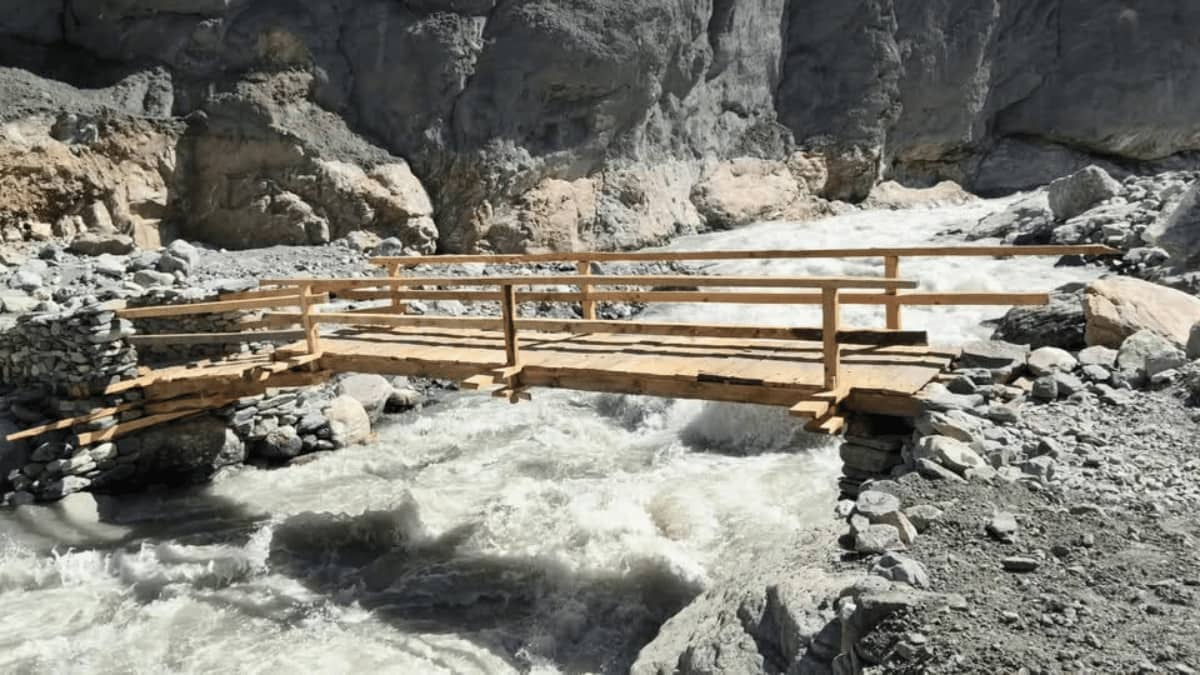
An October 25 morning report from MCAP still described the route as disrupted. Later reporting that day on TAAN's updated advisory stated that residents had installed four wooden bridges and repaired trails around Sardi Khola, allowing travel toward Chhekampar and Mu Gompa.
Why the Tsum Valley Reopening Needs Careful Interpretation
These reports reflect a rapidly changing restoration effort.
The newer TAAN advisory supports the conclusion that access had resumed. However, the earlier MCAP account documents the extent of damage, and the new crossings were wooden replacements rather than confirmation of permanent bridge reconstruction.
Anyone planning Tsum Valley should verify that the new bridges are still operational, that the route is suitable for the group, and that accommodation and transport arrangements are realistic.
Manaslu Circuit vs. Tsum Valley After the Flood
Factor | Manaslu Circuit | Tsum Valley Trek |
|---|---|---|
Reported reopening | October 2026 | October 25, 2026 |
Principal flood concern | Lower Budhi Gandaki trail and road access | Sardibhir crossing and Tsum access trail |
Restoration reported | Trails, bridges, roads, bypass | Four wooden bridges and trail repairs |
Main trekking objective | Cross Larkya La Pass | Explore Tsum settlements and monasteries |
High-altitude challenge | Larkya La at approximately 5,106 m | Mu Gompa around 3,700 m |
Pre-departure priority | Verify bypass, crossings, pass conditions | Verify replacement bridges and valley access |
Is Tsum Valley Open?
The Tsum Valley Trek was reported reopened on October 25, 2026, after community-led repairs installed four wooden bridges and restored damaged trail sections near Sardi Khola. Earlier reports that day still described access as blocked. Travellers should use the newer reopening update while independently confirming temporary crossing conditions before departure.
Can You Plan the Manaslu Circuit Trek for 2027?
Yes. The reopening is a positive development for trekkers planning spring or autumn 2027, and there is no reason to assume that the October 2026 disruption will automatically prevent all trekking the following year.
However, it is too early to certify conditions for April, October, or November 2027.
Further bridge construction, winter weather, spring maintenance, and the 2027 monsoon may change sections of the route before travellers arrive.
Best Time for the Manaslu Circuit Trek in 2027
Season | Months | Planning consideration |
|---|---|---|
Spring | March–May | Generally favourable trekking season; check remaining winter snow and high-pass conditions |
Monsoon | June–August | Greater concern for rain, landslides, river levels, and road disruption |
Autumn | September–November | Popular trekking season; verify route stability after the monsoon |
Winter | December–February | Colder temperatures, snow, and possible difficulties crossing Larkya La |
For travellers selecting between spring and autumn, the decision should not depend on the calendar alone.
Spring 2027 departures should consider winter damage and available passage over Larkya La. Autumn departures should pay particular attention to the condition of the lower valley after the summer rains.
If your flights are not yet booked, building one or two flexible days into your overall Nepal holiday is sensible.
What Should You Check Before Booking the Manaslu Trek?
Rather than relying on a website that simply says the trek is open, ask your operator to explain the route section by section.
These are the questions that matter most:
- Has road access to Machha Khola been reconfirmed?
- Are the bridges between Machha Khola, Jagat, and Philim passable?
- Is the Yaru Bagar alternative still in use?
- Have the Tsum Valley crossings been inspected recently?
- Are teahouses receiving sufficient food and supplies?
- Is there an updated assessment of snow and weather around Larkya La?
- What alternatives are available if the route becomes unsafe?
- Are the trekking permits and guide arrangements in place?
- Does the travel insurance cover emergency evacuation at the trek's maximum elevation?
A trekking operator should be prepared to identify what it knows and what still needs verification.
For a remote route such as Manaslu, realistic uncertainty is more useful than an unconditional safety promise.
Do You Still Need Trekking Permits and a Guide?
Yes. The flood-related reopening does not eliminate the Manaslu region's normal trekking permit requirements.
TAAN's October 25 advisory reported that the Department of Immigration and MCAP had confirmed permit availability. That means administrative access had resumed, not that trekking regulations were suspended.
Travellers should plan for the applicable Manaslu Restricted Area Permit, Manaslu Conservation Area Permit, and any additional permits required by their chosen route, including the Annapurna Conservation Area section of the circuit.
Restricted-area trekking requires arrangements through an authorised trekking agency and an appropriately licensed guide. Group eligibility, permit costs, and documentary requirements should be reconfirmed for the 2027 season.
What Should Your Insurance Cover?
Choose a policy appropriate for remote, high-altitude trekking. Check that the policy explicitly covers trekking above 5,000 meters, emergency evacuation when medically necessary, and medical treatment.
Do not assume ordinary travel insurance provides helicopter evacuation coverage.
Also check exclusions for government restrictions, road closures, extreme weather, or cancellations caused by natural disasters.
How Mountain Eco Trails Can Help You Plan the Manaslu Circuit Trek
The biggest mistake after a natural disaster is to focus only on whether the destination has reopened.
For trekkers, the more important question is whether you can organise the entire planned journey responsibly, from road access to accommodation, acclimatisation, and the high-pass crossing.
Mountain Eco Trails is a Nepal-based trekking and tour operator with more than 10 years of experience organising Himalayan journeys.
For travellers interested in the Manaslu Circuit in 2027, we can help plan an itinerary around your group size, trekking experience, preferred month, and available days, with pre-departure route verification built into the planning process.
Our approach is to distinguish reported route access from conditions that must still be checked. We do not recommend treating a temporary bridge or a general reopening notice as a guarantee of safe passage.
Plan Your Manaslu Trek for 2027
Whether you are considering the classic Manaslu Circuit or adding Tsum Valley, share your travel dates and questions about the flood-affected sections.
- WhatsApp Us Email an Inquiry
- Email: [email protected] | WhatsApp: +977 9849790153
What If the Route Changes Again Before Your Trek?
Flood recovery is not a single event. A newly installed bridge may later be replaced by a permanent structure, a bypass may be improved, or another period of heavy rain may require fresh restrictions.
That is why it is useful to separate trekking planning into three decisions.
First, decide whether Manaslu is the right destination for your fitness, expectations, and holiday duration.
Second, arrange a suitable itinerary with a realistic approach to altitude and local transport.
Third, reconfirm the entire route shortly before departure, including the day you enter the flood-affected corridor.
If an essential crossing is unsafe, postponing, modifying the route, or choosing a different Nepal trek may be the appropriate decision. An itinerary should never be more important than the people following it.
Manaslu Trekking in 2027
The Manaslu Circuit Trek is a reasonable destination to consider for 2027 because trekking resumed after the October 2026 flood. However, reopening in 2026 cannot guarantee conditions in 2027. Travellers should choose a suitable season, plan adequate acclimatisation, and obtain updated information about bridges, access roads, teahouses, and Larkya La before starting.
Frequently Asked Questions About the Manaslu Circuit After the Flash Flood
1. Is the Manaslu Circuit Trek open after the October 2026 flash flood?
Yes. According to TAAN's October 25, 2026 advisory, the Manaslu Circuit via Larkya La has resumed operating after repairs to damaged trails and bridges. Access from Machha Khola has been reported restored, although some sections require alternative paths and extra caution.
2. Is Manaslu Circuit Trek safe after the flood?
Yes, the Manaslu Circuit Trek is safe after the flash flood. The trek is accessible, but reopening does not guarantee safety. Temporary crossings, unstable trail sections, weather, and high-altitude conditions still need attention. Travellers should use a qualified guide, verify current local conditions, and avoid proceeding where a crossing or trail has become unsafe.
3. Is the Tsum Valley Trek route open after the flood?
Yes, the Tsum Valley Trek Route is open after the flood. A TAAN advisory reported on October 25, 2026, confirmed that Tsum Valley trekking had resumed following the installation of four wooden bridges and repairs around Sardi Khola.
4. Which part of the Manaslu Circuit was damaged by the flood?
The October 11 flood damaged parts of the lower Budhi Gandaki route, including locations around Khorlabesi, Tatopani, Yaru Bagar, Jagat, and Salleri. The Sardibhir crossing toward Tsum Valley was also affected. Repair work subsequently restored access through several of these locations.
5. Can I book the Manaslu Circuit Trek for April 2027?
Yes, April is generally a suitable month to consider for Manaslu trekking. However, the condition of flood-repaired infrastructure in April 2027 has not yet been established. Verify the approach road, bridges, accommodation, and Larkya La snow conditions before confirming the final walking schedule.
6. Will the October 2026 flood affect the Manaslu Circuit Trek in autumn 2027?
It is too early to know. Repaired trails may be further improved before autumn 2027, but the intervening monsoon could also create new damage. Trekkers visiting in September, October, or November should request a fresh route assessment after the rainy season.
7. Are teahouses open along the Manaslu Circuit after the flood?
October 25 reporting confirmed that hotels in Jagat were providing food and accommodation, while trekkers were reaching the upper circuit. However, supply transport had experienced disruption. Travellers should check lodge operations and availability along their complete route rather than assuming every facility has fully recovered.
8. Do I need a guide for the Manaslu Circuit Trek in 2027?
Yes. The Manaslu Circuit includes restricted-area trekking where an authorised agency and licensed guide arrangements are required. Beyond regulations, an experienced guide is particularly valuable when navigating repaired paths, responding to weather changes, managing altitude-related concerns, and coordinating with local communities.
9. Is Larkya La Pass open after the October 2026 flood?
The Manaslu Circuit route toward Larkya La was reported operating again in October 2026. However, a general reopening notice is not a live pass-weather forecast. Snow, ice, wind, and altitude can affect the crossing independently of damage along the lower Budhi Gandaki Valley.
10. How can I receive a reliable Manaslu Circuit route update before trekking?
Check recent notices from TAAN, the Manaslu Conservation Area Project, local authorities, and your trekking operator. Ask for information specific to your intended departure rather than relying on older announcements. Mountain Eco Trails can help review the route and arrange a suitable 2027 itinerary.
Final Thoughts: Reopened Does Not Mean Risk-Free
The October 11 flood was a serious disruption for the Manaslu region, especially for communities whose everyday access depends on bridges and walking trails along the Budhi Gandaki.
The reopening of the Manaslu Circuit and the reported restoration of Tsum Valley access are encouraging signs of recovery.
For trekkers, the correct conclusion is neither that Manaslu should be avoided indefinitely nor that the region is completely back to normal.
It is that Manaslu is welcoming trekkers again, with additional route awareness and sensible precautions still necessary.
If you are dreaming of crossing Larkya La in 2027, start planning the journey, but leave room for new information. The mountains will still demand patience, and that is part of what makes trekking in Manaslu such a meaningful experience.

Anil Lamsal
Call us on WhatsApp+977 9849790153OrChat with us